Recently, a case of a huge pink rabbit lying ‘dead’ and decaying over the years in a mountainous terrain circulated on social media. The odd situation caught our attention. The pink rabbit, Hase, is a work by Gelitin, an art body originating from Austria, formerly known as Gelatin. Four individuals, Ali Janka, Florian Reither, Tobias Urban, and Wolfgang Gantner, have been playing together since 1978, exhibiting internationally since 1993. The recent book Gelatin ATLAS Gelitin (2022) documents all exhibitions between 2008 and 2022 and gives a sense of their immense universe.
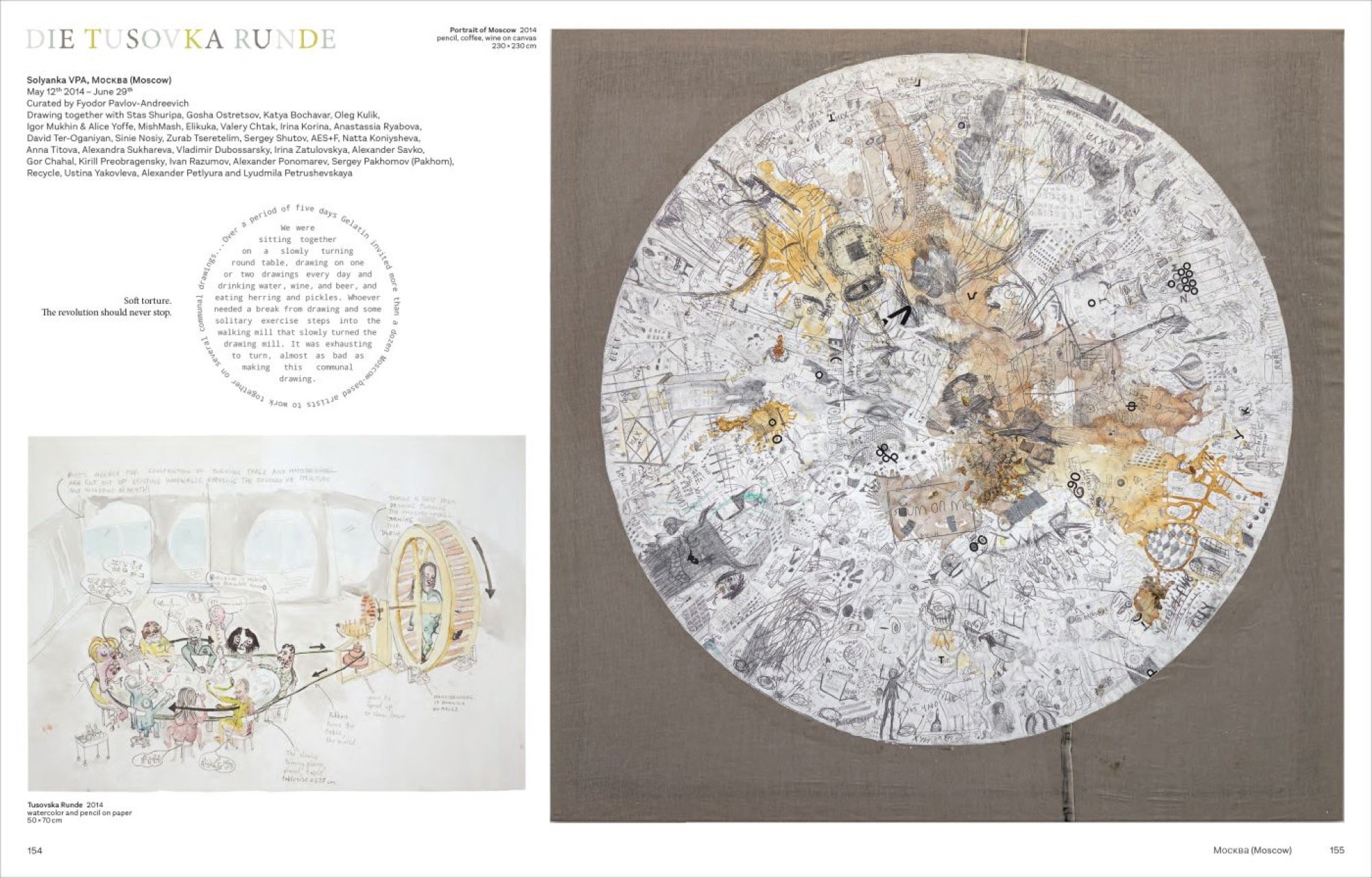
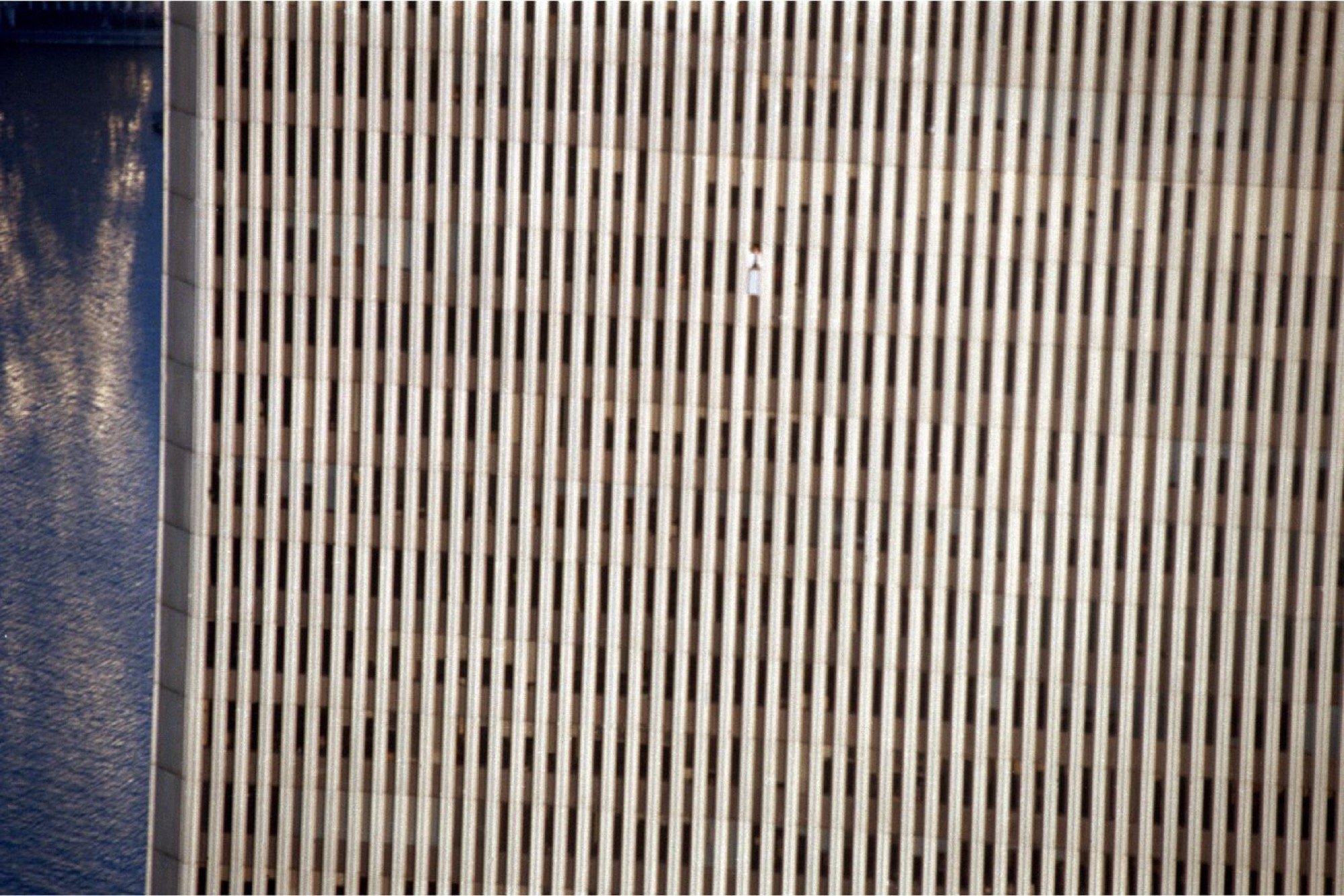
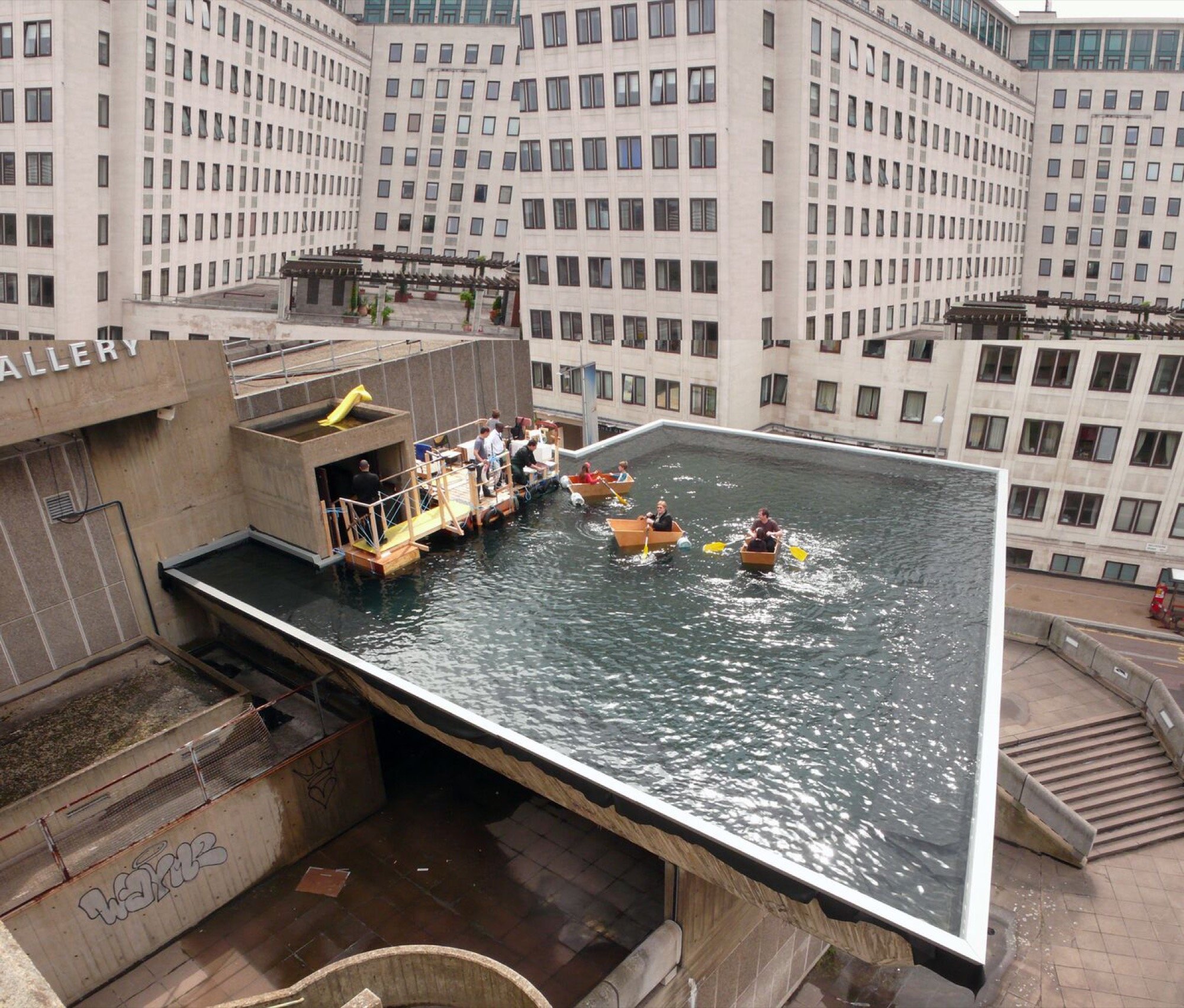
Their universe, however, stretches back further. It also includes building a load-bearing balcony from the World Trade Centre’s window in New York City (The B-Thing, 2000), or making an infinity pool on the roof of London’s Hayward Gallery (Normally, Proceeding and Unrestricted With Without Title, 2008), or constructing a Human Elevator from bodybuilders (Pearl M. Mackey Apartments, Los Angeles, USA,1999), and many more.
Selected page from the book Gelatin ATLAS Gelitin (2022).
Often including explicit body parts, excrement, or their allusion, and frequently involving performances, live sculpture, and participatory events in and outside the gallery, the works are marked as “absurd,” “bizarre,” “transgressive,” “playful,” “chaotic,” and “boundary-pushing.” They may be offensive to some and amusing to others. While appearing to be a joke-like, there is a quality of intellectual humour in their practice, one that punches through the boundaries between public and private, one and many, me and you, inside and outside.
They share very little explanation themselves; Artforum described their work as turning “the art market into a playful grotesquerie where the real meets the absurd, driven by the power of satire,” while Greene Naftali framed them as exemplars of relational aesthetics, taking social interaction as their subject. While satire could deflate into cynicism, their punkish (we don’t give a damn) approach helps them to evade a woe-is-me attitude by mocking themselves with a raised chin, producing uncomfortable acts.
For this article, we focus on works by Gelitin that use the medium, themes or motifs related particularly to landscape architecture. What matters in this context is Gelitin’s nonchalant approach to culture and the blunt honesty that flips the politics and perception of the traditional and appropriate, exposing our limitations within the (somewhat uptight) ideals of beauty, truth and transparency.
The Rock Garden
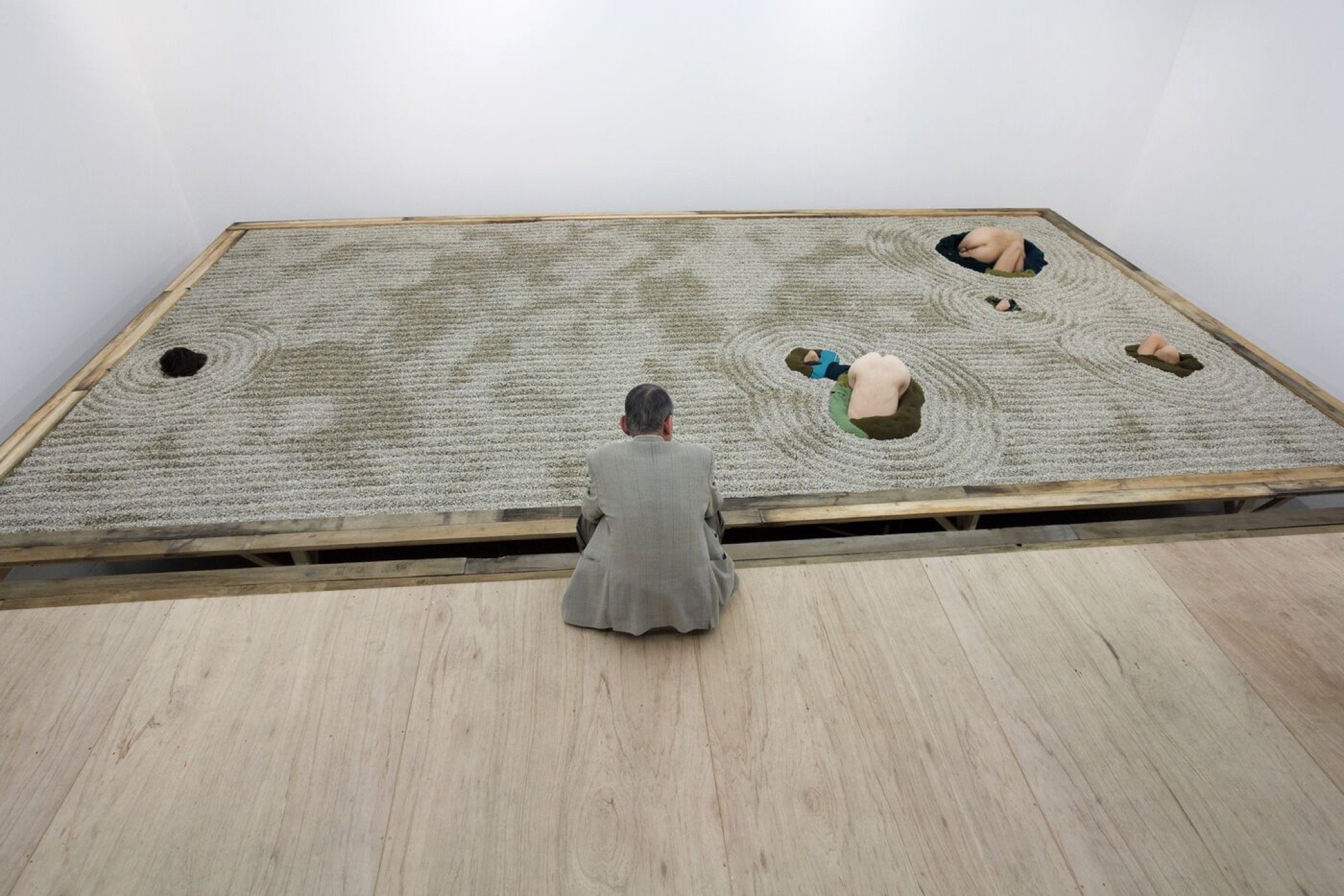
In the Klunk Garden (2009), set up in the Tomio Koyama Gallery in Tokyo, Gelitin made an in-gallery replica, or rather enactment, of the traditional Japanese zen garden, Ryōan-ji. The rocks of the original kare-sansui (dry garden) become animated. Human body parts poke through the still, raked gravel surface, and we no longer have a choice but to consider animism. Becoming the rock, or rock becoming the body, who are we to judge otherwise? Ryōan-ji, one of the most visited and studied gardens in the world, was designed to prompt reflection on emptiness, impermanence, and the limits of perception. Gelitin amplifies its logic: reaching satori meditating in the Klunk Garden is, indeed, another level of zen.
Photo: Kei Okano.
The Tree in Public Space
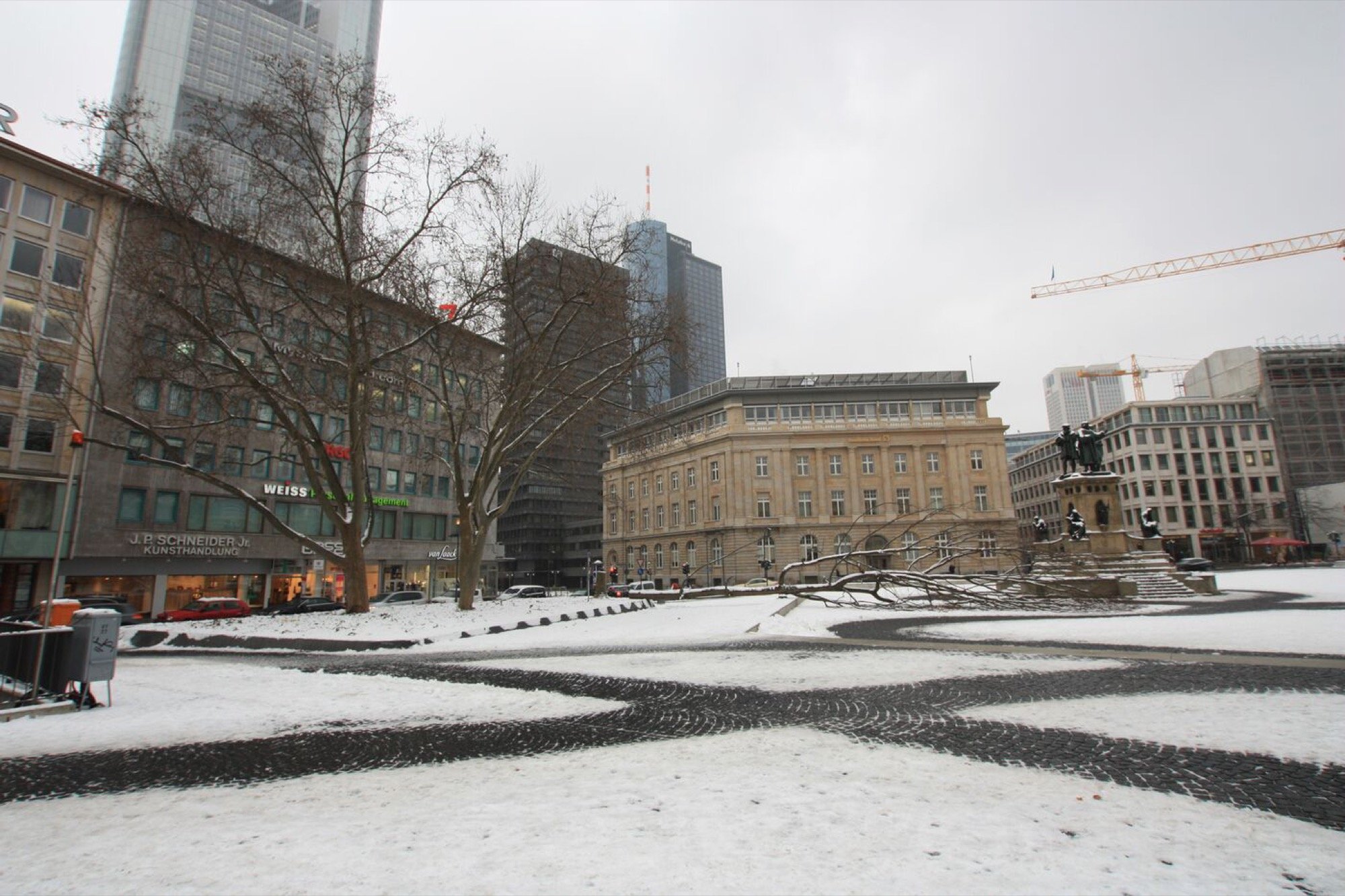
In 2012, Gelitin placed a felled tree across the Rossmarkt square in Frankfurt am Main, Germany. The tree corpse blocked passage over the square’s “wasteland” for almost half a year, “suspending the definition of the square”. The artwork Kühlschrank, Bett, Tastatur (Refrigerator, Bed, Keyboard) is not about the fallen tree, but everything around it. A tree lying across a square is a scandal not because it is ugly, but because it is wrong. It is also wrong that it is regarded as an art project. Disturbance in functionality could open a crack in the routine between the bed, refrigerator and keyboard – the architecture of overproduction.
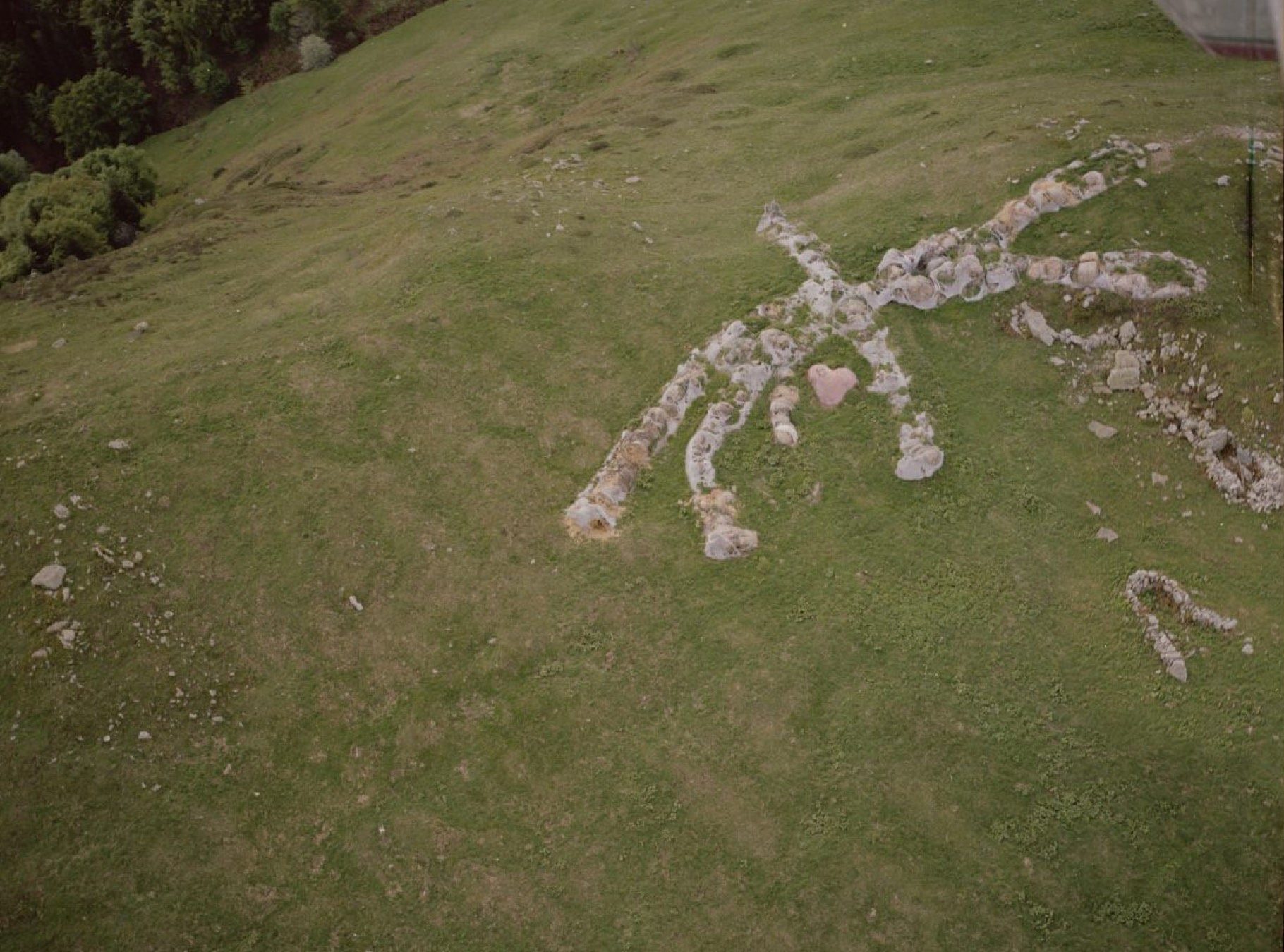
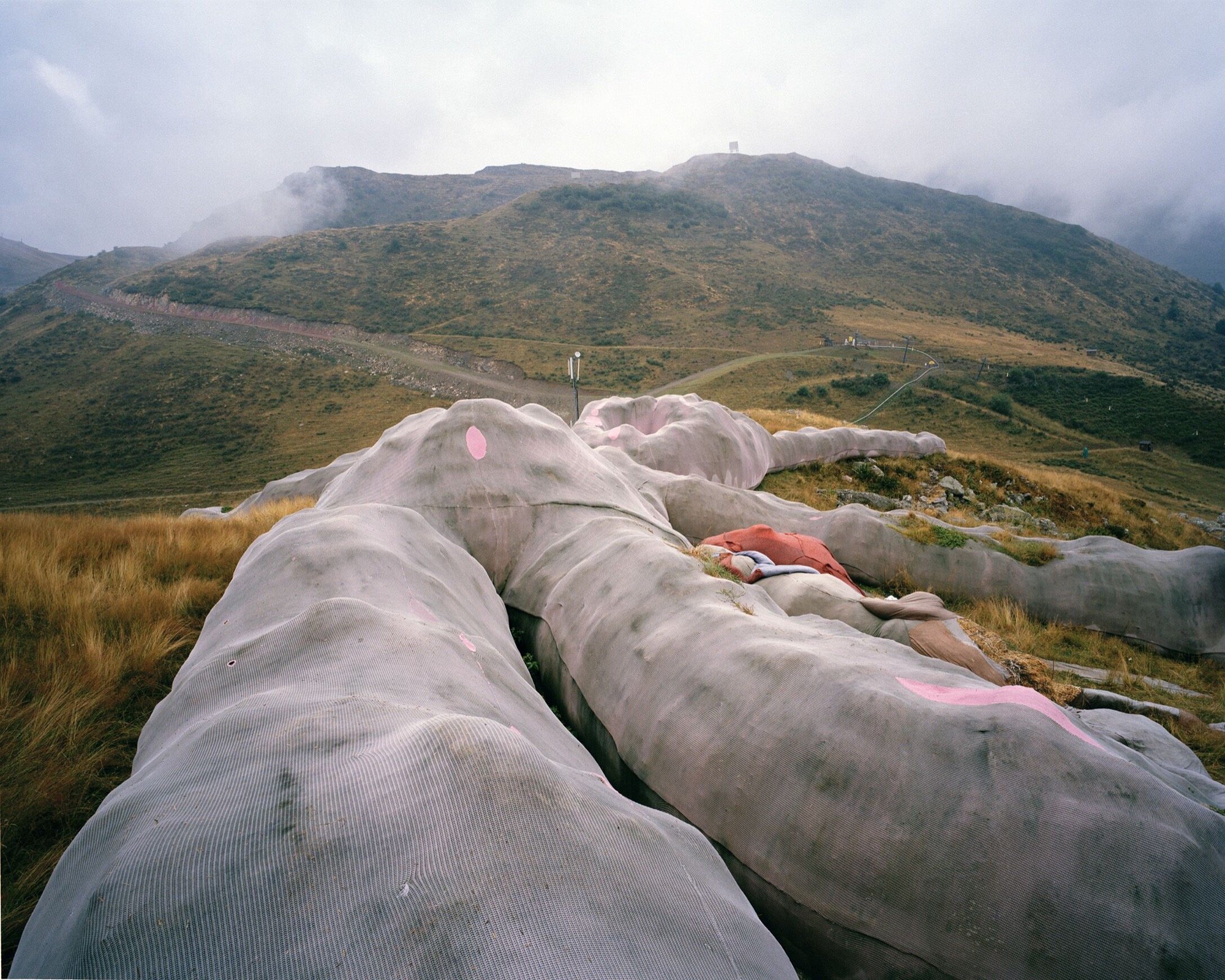
Lastly, there is Hase, the wool-knitted giant pink rabbit that dropped from the sky onto the mountains of Artesina in the Italian Alps in 2005. Measuring some 55 metres in length, stuffed with straw, and lying at an awkward angle, it was left there for twenty years, decaying in the presence of visitors and climate alike. What is interesting, besides how the bunny was altered in the process, is how the landscape itself was changed by this alien creature.
Open-air museums and land art installations are not unusual. But they typically operate in a naturalesque style, a careful, reverent insertion of artworks into an idealised dialogue with surroundings. Land art usually works in sync with the landscape, exposing its latent power: Walter de Maria‘s The Lightning Field frames the electrified sublime of the New Mexico plain; Robert Smithson‘s Spiral Jetty reads the geological time of Great Salt Lake, Christo and Jeanne-Claude’s wrappings reveal volume and surface. Gelitin, by contrast, dropped a “toilet-paper-pink” (Gelitin) stuffed creature on top of a hill and left it to rot. The “landscape of the rabbit’s body” ultimately merges with the mountain, while human visitors are, happily, maggots and larvae falling through its broken, overspilling body.
Hase produces a similar defamiliarising effect on the landscape that Gordon Matta-Clark‘s Splitting (1974) produced on the family house. One does not need to see it in situ for the message to come through. No family house looks the same after Splitting — the idealised dream of a happy domestic life was cut through its gut. No alpine meadow looks the same after Hase — the dreamy vernacular landscape is forever dead. It was taken over by the rabbit, “a country dropped from the sky”.
This image is so foreign to nature, recreation, happy weekends and holidays, and to ecological and land art, that it brings a joy of disillusionment — as if the bunny’s decay is the death of pretence-innocence, altering the mountain’s signified. Seeing people visiting it is, in fact, sad. The ultimate pleasure is in death and decay, in self-dissolution. Gulliver in Lilliput is dead on the spot.
Since Gelitin’s work is built on witty flips of art historical references, Hase could easily comment on Jeff Koons’ Rabbit or Beuystalking to a dead hare. In Nellanutella (Venice, 2001), for instance, Gelitin took Yves Klein’s Leap into the Void, ad extremum, and jumped into the Venice canals self-indulgently.
In each of these works, Gelitin unmask the weight of cultural projection – and once seen, it cannot be undone. The absurdity they play with can be read as a reflection of the bluntly obvious, bitter conditions of society. From that angle, and probably many others, their work can be seen as deeply political. Their commentary on public space, the body within it, and its conditioning is worth exploring. As if their work spoke about dissolving the body into mud, a collective body, one that resists all formality.
2 thoughts on “Gelitin: The Landscape Lost to a Rabbit”
One line stuck with me: “Seeing people visiting it is, in fact, sad.” Why? Gelitin made a 55-meter pink rabbit. People came to see it. That seems like a success. For me the sadness isn’t in the work or the visitors, it’s in a way of writing about art that needs the audience to be missing the point so the author can be the one who gets it.
Feels like the text wants the work to be heavier than the artists made it.
Thank you for the comment. I do find it heavy even if that was not intended. I don’t know why that is bad or wrong. Perhaps I should clarify the sadness, I didn’t write about the art being sad, but the “happy” pilgrimage towards decay.
To provide the best experiences, we use technologies like cookies to store and/or access device information. Consenting to these technologies will allow us to process data such as browsing behavior or unique IDs on this site. Not consenting or withdrawing consent, may adversely affect certain features and functions.
Functional
Always active
The technical storage or access is strictly necessary for the legitimate purpose of enabling the use of a specific service explicitly requested by the subscriber or user, or for the sole purpose of carrying out the transmission of a communication over an electronic communications network.
Preferences
The technical storage or access is necessary for the legitimate purpose of storing preferences that are not requested by the subscriber or user.
Statistics
The technical storage or access that is used exclusively for statistical purposes.The technical storage or access that is used exclusively for anonymous statistical purposes. Without a subpoena, voluntary compliance on the part of your Internet Service Provider, or additional records from a third party, information stored or retrieved for this purpose alone cannot usually be used to identify you.
Marketing
The technical storage or access is required to create user profiles to send advertising, or to track the user on a website or across several websites for similar marketing purposes.
To provide the best experiences, we use technologies like cookies to store and/or access device information. Consenting to these technologies will allow us to process data such as browsing behavior or unique IDs on this site. Not consenting or withdrawing consent, may adversely affect certain features and functions.
Functional
Always active
The technical storage or access is strictly necessary for the legitimate purpose of enabling the use of a specific service explicitly requested by the subscriber or user, or for the sole purpose of carrying out the transmission of a communication over an electronic communications network.
Preferences
The technical storage or access is necessary for the legitimate purpose of storing preferences that are not requested by the subscriber or user.
Statistics
The technical storage or access that is used exclusively for statistical purposes.The technical storage or access that is used exclusively for anonymous statistical purposes. Without a subpoena, voluntary compliance on the part of your Internet Service Provider, or additional records from a third party, information stored or retrieved for this purpose alone cannot usually be used to identify you.
Marketing
The technical storage or access is required to create user profiles to send advertising, or to track the user on a website or across several websites for similar marketing purposes.







One line stuck with me: “Seeing people visiting it is, in fact, sad.” Why? Gelitin made a 55-meter pink rabbit. People came to see it. That seems like a success. For me the sadness isn’t in the work or the visitors, it’s in a way of writing about art that needs the audience to be missing the point so the author can be the one who gets it.
Feels like the text wants the work to be heavier than the artists made it.
Thank you for the comment. I do find it heavy even if that was not intended. I don’t know why that is bad or wrong. Perhaps I should clarify the sadness, I didn’t write about the art being sad, but the “happy” pilgrimage towards decay.