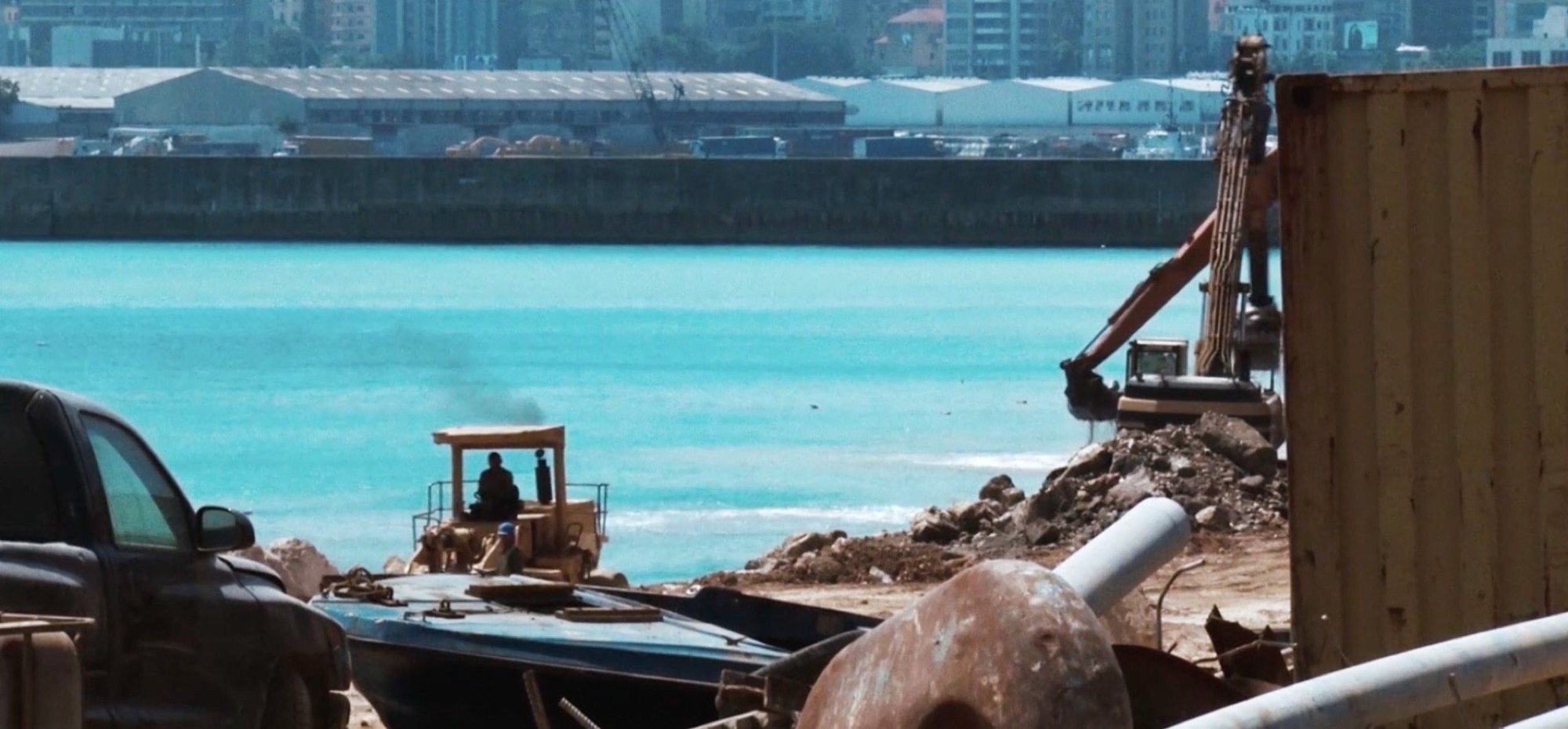
Topophilia video still by Peter Bo Rappmund, showing built and natural environments along the 800-mile length of the Trans-Alaska Pipeline. Source: https://vimeo.com/112672912
Topophilia, or the “affective bond between people and place or setting”, as human geographer Yi-Fu Tuan defines the term in Topophilia: A Study of Environmental Perception, Attitudes and Values (1974), is reconsidered in this article, specifically in relation to the increasing presence of solastalgia, or the inability to find comfort due to negatively perceived changes in our lived environments. The disorientation brought about by accelerating modernisation and the continuous restructuring of the material world is already rounded through the development of Faust’s character by Marxist urbanist Marshall Berman in All That Is Solid Melts into Air (1982). The present condition suggests a more specific shift. Not only change within place, but the erosion of place itself. One might describe this as a disruption of ‘place by time’. How then to forge a connection with our environment in a time when place is disappearing?
All that is solid melts into air. Video still, directed by Directed by Amy Dang.
If the inability of attachment to place is to be considered, the distinction between space and place requires attention. Prior to geographical accuracy, as Yi-Fu Tuan observes, territorial worldviews were constructed through ethnocentric structures, where maps positioned a known centre and extended outward into the unknown. In western Europe, for example, Delphi was considered the centre until this view shifted through exploration, and Greece could no longer sustain that position. Similarly, the “loss of place” is examined by Edward S. Casey in The Fate of Place, where topogenesis is linked with cosmogenesis. The inward-oriented place, bound by location, gradually lost significance against an outward-oriented, infinite conception of space shaped by developments in theology and physics. Place, once lived, embodied, and situated, became subordinated to abstract space within Western thought. As Yi-Fu Tuan writes, “On the time scale of cultural evolution, the onset of urbanism, with the concomitant development of ideas of transcendence, broke the shell of place-bound, life-nurturing neolithic communities”.
While Tuan’s Topophilia draws on various scattered insights from culture, literature, physiology, and perception, it asserts that value and attachment are co-constructed through cultural history, biological disposition, upbringing, education, and physical surroundings. Topophilia encompasses aesthetic appreciation, the feeling of home as a locus of memory, and the conditions of livelihood. Yet this account presumes that place persists long enough to accumulate meaning. With the collapse of places into what is often described as non-places, the flattening of sensory experience, and the erosion of local cultural distinctions, topophilia seems a nostalgic emotion.
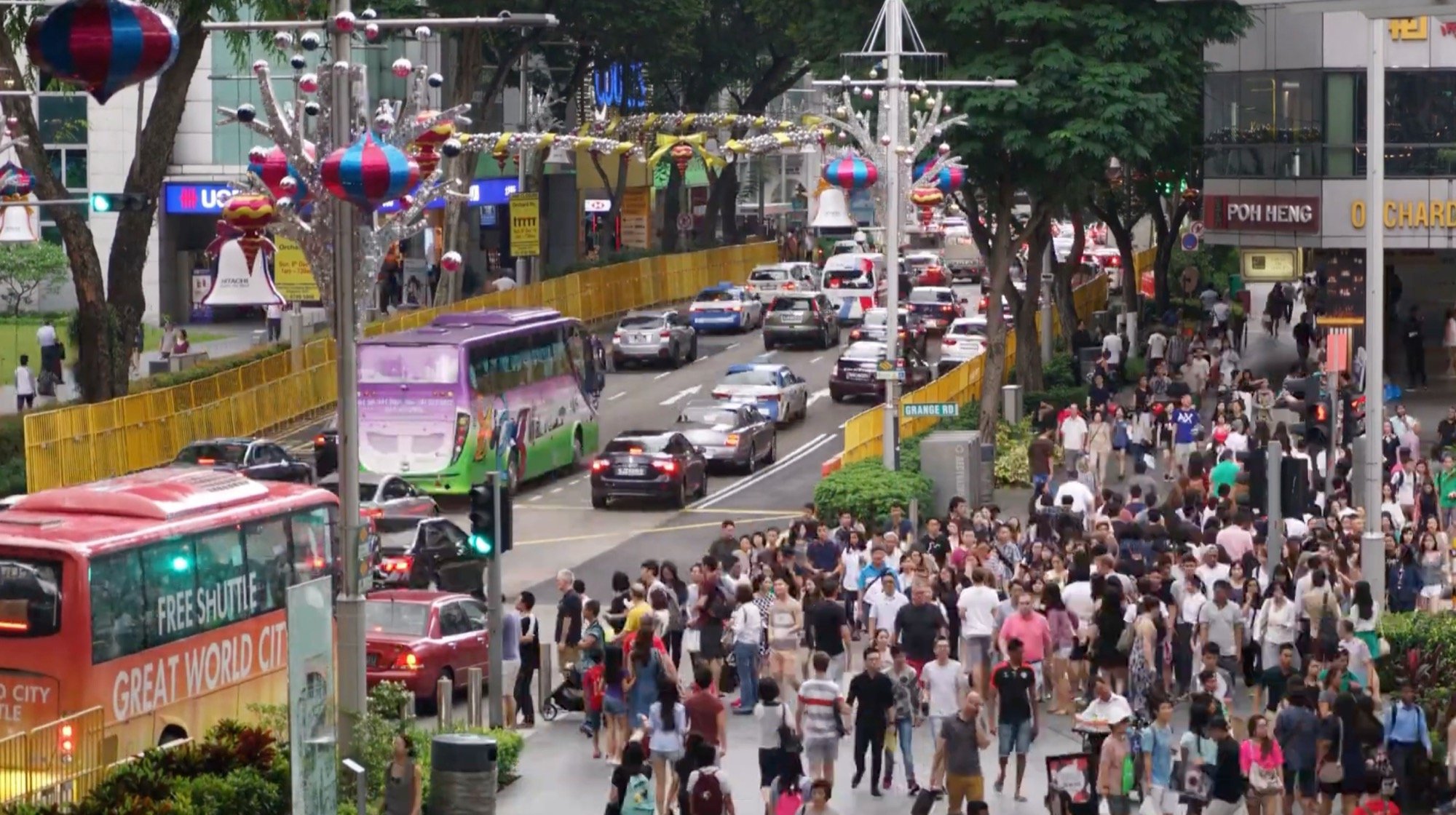
This instability is prefigured in Marc Augé’s notion of “non-places”, environments of transit and consumption that do not accumulate meaning through time. Airports, highways, and shopping centres are not devoid of experience, but they resist attachment. They are designed for circulation rather than duration, for use rather than memory. The distinction may be schematic, but it identifies a condition in which environments remain functional while failing to thicken into place. This in-betweenity, or the late-modernity’s Junkspaces, promped by Rem Koolhaas, are distinguished by “erasure of narrative, coherence, and identity, functioning as a spatial residue of late capitalism”.
Non-place. By 颐园新居 – Own work, CC BY-SA 3.0. Source: Wikipedia Commons.
Doreen Massey, in A Global Sense of Place (1991), writes that the “idealised notion” of an era in which places were inhabited by coherent and homogeneous communities is set against a present, marked by fragmentation and disruption under conditions of ‘time-space compression’. The search for a sense of place becomes a search for “fixity and for security of identity in the middle of all the movement and change”, and risks becoming reactionary. She questions the “search after the ‘real’ meanings of places”, the unearthing of heritages as if they could stabilise identity. In this framing, place is positioned against movement, dismissed as “romanticised escapism from the real business of the world”, while time is aligned with progress and mobility.
Massey’s question remains: how to hold on to geographical difference, even to rootedness if desired, without it becoming reactionary. Her response does not reject place, but redefines it. Place is not an inward construction but a constellation of relations, an intersection of trajectories, a meeting, a process. It is not bound by a boundary, but articulated through the relations and conflicts that shape it across time. Its specificity lies not in internal coherence, but in the wider networks to which it is connected. Junkspace fills the space void of meeting: “Flows depend on disciplined movement, bodies that cohere. Junkspace is a web without spider; although it is an architecture of the masses, each trajectory is strictly unique“.
Community, Massey notes, has persistently been tied to place in problematic ways. Communities can form independently of location, and if people are recognised as having multiple identities, the same must be said of places. Acknowledging this heterogeneity makes possible what she terms a “global sense of place”.
Attachment to place, as studies suggest, is tied more to social relationships within a local context than to the place itself. This does not resolve into a choice between constructing identity or allowing multiplicity. The question is whether design can meaningfully produce either. Under conditions of displacement and continuous transformation, identity and social relations exceed design intentions. Place-making and community-building persist as stated objectives, yet often remain declarative.
Attempts to quantify topophilia through quality-of-life indicators translate it into measurable components such as visual preference, safety, or access to restorative environments. Such approaches risk mistaking environmental comfort for attachment, overlooking the temporal and experiential depth through which places acquire meaning. Topophilia cannot be reduced to landscape elements. It holds a charge far more nuanced, unable to be described by landscape components, but by the particular wall, the bench, the path, the park, and the memories allocated and the experiences lived there. The place, then, is not a design project but a personal making.
Henri Lefebvre’s distinction between conceived, perceived, and lived space further exposes this gap. Landscape architecture operates largely within conceived space, while its claims are directed toward lived experience. If the production of space precedes the experience of place, then attachment is always contingent. In other words, topophilia depends on created conditions that may no longer exist in the near future. The instability produced by capital flows independent from people’s experience cannot secure a place for a memory to hold.
Production of Space. Video still: Decoding Henri Lefebvre: The Production of Space.
These accounts describe a conceptual instability of place. What they do not yet fully address is its material counterpart. Places are not only reinterpreted through mobility or abstraction. They are altered, degraded, and, in some cases, removed altogether. The theoretical instability of place is experienced directly.
Eroding Places
Change is perceived if it occurs suddenly. The tree is invisible growing, but becomes visible in its absence. A tree removed, a building demolished, a landscape altered beyond recognition. What was gradual becomes immediate.
To experience ongoing transformation without the capacity to influence it produces a specific form of distress. Solastalgia, as defined by Glenn Albrecht, describes this condition as “place-based distress” caused by environmental change beyond one’s control. Solastalgia is not nostalgia, since it does not arise from having left home and longing to return. It is, rather, a form of homesickness one experiences when the present environment no longer offers solace. What is altered is the relation between identity and place, between psychic stability and the possibility of finding comfort in one’s surroundings. The distress can be existential. It emerges when the lived ground of continuity is undermined by forces that exceed personal or communal control, whether mining, land clearing, drought, demolition, pollution, war, or rapid urban transformation. With the loss of familiarity, the sense that one’s place in the world remains inhabitable is heightened.
For landscape architecture, this instability presents a limit rather than a task. The discipline cannot produce attachment, only conditions under which it may or may not emerge. In a context where places are continuously transformed, standardised, or eroded, the aspiration to create a sense of place risks becoming formal or rhetorical. As Zaš Brezar suggests, the stability once associated with genius loci gives way to a condition of constant transformation, a genius mutabilis. Design is no longer concerned with permanence, but with engaging change as the primary condition of place. Or, as Koolhaas say the plan would make matters worse, pushing one into despair: “There is zero loyalty – and zero tolerance – toward configuration, no ‘original’ condition; architecture has turned into a time-lapse sequence to reveal a ‘permanent evolution’…. The only certainty is conversion – continuous – followed, in rare cases, by ‘restoration,’ the process that claims ever new sections of history as extensions of Junkspace“.
Landscape architecture operates in the condition of place erosion without the capacity to resolve it. It works in environments already shaped by extraction, climate instability, and uneven development. It intervenes in places that are often uncomfortable, contested, or damaged. In this context, the ambition to produce attachment becomes uncertain. For some, interventions may provide moments of use or encounter. For others, they may coincide with displacement or loss. For more-than-humans, they may register as a further disturbance. What can be offered is limited. Not the restoration of a stable relation, but the possibility of situated acts. A place to sit, to pause, to meet. Not as a guarantee of belonging, but as an opening. Design, in this sense, does not produce place. It makes space available for it, without determining what it will become. Working with Running Room, to use Hal Foster‘s junkspace counterpart, might give landscape architecture some breathing space, at least conceptually, carving out “critical and resistant zones—conceptual ‘rooms’ for movement, agency, and design innovation”.
To provide the best experiences, we use technologies like cookies to store and/or access device information. Consenting to these technologies will allow us to process data such as browsing behavior or unique IDs on this site. Not consenting or withdrawing consent, may adversely affect certain features and functions.
Functional
Always active
The technical storage or access is strictly necessary for the legitimate purpose of enabling the use of a specific service explicitly requested by the subscriber or user, or for the sole purpose of carrying out the transmission of a communication over an electronic communications network.
Preferences
The technical storage or access is necessary for the legitimate purpose of storing preferences that are not requested by the subscriber or user.
Statistics
The technical storage or access that is used exclusively for statistical purposes.The technical storage or access that is used exclusively for anonymous statistical purposes. Without a subpoena, voluntary compliance on the part of your Internet Service Provider, or additional records from a third party, information stored or retrieved for this purpose alone cannot usually be used to identify you.
Marketing
The technical storage or access is required to create user profiles to send advertising, or to track the user on a website or across several websites for similar marketing purposes.
To provide the best experiences, we use technologies like cookies to store and/or access device information. Consenting to these technologies will allow us to process data such as browsing behavior or unique IDs on this site. Not consenting or withdrawing consent, may adversely affect certain features and functions.
Functional
Always active
The technical storage or access is strictly necessary for the legitimate purpose of enabling the use of a specific service explicitly requested by the subscriber or user, or for the sole purpose of carrying out the transmission of a communication over an electronic communications network.
Preferences
The technical storage or access is necessary for the legitimate purpose of storing preferences that are not requested by the subscriber or user.
Statistics
The technical storage or access that is used exclusively for statistical purposes.The technical storage or access that is used exclusively for anonymous statistical purposes. Without a subpoena, voluntary compliance on the part of your Internet Service Provider, or additional records from a third party, information stored or retrieved for this purpose alone cannot usually be used to identify you.
Marketing
The technical storage or access is required to create user profiles to send advertising, or to track the user on a website or across several websites for similar marketing purposes.