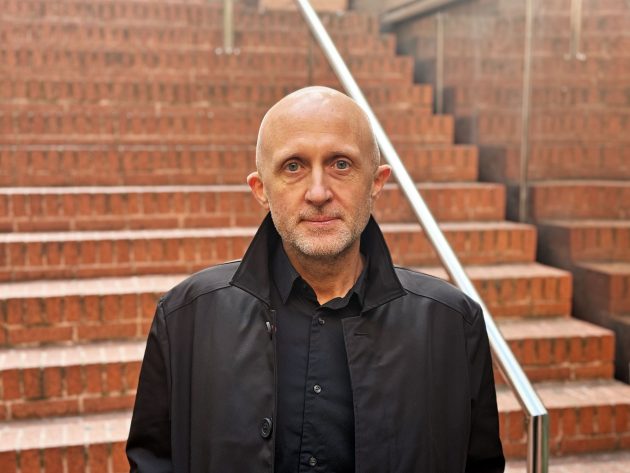




Ed Wall is a landscape architect and professor of ‘Cities and Landscapes’ at Greenwich University. A few months ago we spoke with him about landscape architecture, teaching, and what the profession should aspire to. Today, the conversation takes a darker turn: his new book, Architecture for Warfare, published by Jovis, traces the entanglements between spatial design and the expanding geography of war. It began, as Ed explains, with a moment of bitter revelation during his years in practice as a landscape architect …
Landezine: Can you walk us through that discovery and what it set in motion?
Ed Wall: The book has come about over quite a few years. It takes me back to 2005, when I was working at what was then called EDAW — the largest landscape architecture firm in the world at the time, with studios across the globe doing largely landscape architecture and urban planning work. That year, there was an announcement that EDAW was to merge with AECOM. I was based in New York City, in one of the smaller EDAW offices, with about 20 people. We were, obviously, quite interested in who this multidisciplinary organisation was that was going to be merging with — or buying — us.
A number of colleagues and I started asking questions, and it’s really those questions from 2005 that I’ve continued to ask myself, because they set in motion a number of decisions I made for myself. I don’t think these are particularly unique situations to find yourself in. Many people, at some point in their working lives, question the projects they’re involved in and the ethical background of that work.
You mention a quote by the vice president, saying: “We are AECOM, we can do anything”, seems confident but also chilling at the same time, more so after looking through the lens of your book. Is this the prevailing emotion also downstream in the company’s structures? Is there criticism within the company, or does it simply continue through a collective disavowal?
I spoke to that vice president, and to many others inside AECOM. What I found was a very unevenly distributed knowledge of what the organisation actually did. Particularly during the Iraq War, most people were simply not aware of the military services AECOM provided.
I got a sense that the ‘life cycle’ is, in a way, also implied as a problem in your book, when observed through the lens of war-related reconstruction. Is that the core tension your book investigates?
There are two ways of looking at this. Many large multidisciplinary firms like AECOM promote themselves as offering a full life cycle service — surveying, remediation of polluted land, the design and engineering of facilities, maintenance, and eventually decommissioning. That model is not uncommon and is quite openly described by many big interdisciplinary engineering firms.

What struck me was that in the middle of the US-led invasion of Iraq in 2003, AECOM had received multiple contracts with American agencies to support the invasion — everything from military bases overseas to security personnel with live fire experience. So when, in 2005, my colleagues and I realized that AECOM was involved in supporting the conflict, it felt contradictory that they were simultaneously receiving contracts for reconstruction.
We see this pattern in current conflicts too. It is often very difficult to identify who is receiving contracts, as they are frequently awarded in secrecy, without competition. The question that interested me most was: what does it mean when a single organisation is responsible for supporting a military conflict and profiting from the reconstruction that follows?
In that sense, the ‘life cycle’ gets another kind of dimension of meaning that is much more unsettling.
I think so. It doesn’t take an awful lot of time on search engines on the internet to see the range of services that many large architecture engineering conglomerations offer. And I don’t think it is unreasonable to question the relationship between those different services, the logic for them coming together in a single organisation, or the way in which those services are deployed.
Precisely, and the AI-generated images of the post-war Gaza, produced by the Trump administration, emerged in the times when Israel was comiting genocide there. Which makes one think about the entirety of motives behind that war, and all the industries that benefit from it.
Absolutely. And certainly some of the familiar corporations that came up in my research – such as Tetra Tech and DynCorp, as well as AECOM, are also coming up within the GREAT Trust reconstruction master plan for Gaza that was published by the Washington Post.

On one hand, such unmasking, or foregrounding these entanglements, is productive — but on the other hand, truth seems to produce little resistance today. Trump said recently, regarding Iran: “To be honest with you, my favourite thing is to take the oil.” And life went on.
My particular interest was how all of this came to impact my world and my work — the world around me, and most recently the work of my students — and what questions that raises.
I don’t usually undertake research with an expectation of having impact, to be honest. And while I have a particular ethics or critique that I touch on in the book, many people don’t share it. Many people recognise the economic value that warfare brings, the economic value of colonial endeavours, and military contracts. And they are either sanguine or pragmatic about it, or even enthusiastic.
Often the conversation in the architectural industry is: “If we don’t do it, somebody else will.” And that reasoning applies to all types of commissions that may feel questionable. It doesn’t surprise me that the unveiling hasn’t slowed things down. We are in a very peculiar time in terms of how powerful countries are using their power against those with less.
For people who are critical of large media organizations, it’s not surprising that mainstream narratives don’t always get to the details we might hope for. David Harvey describes quite succinctly, in his work on capitalism, the contradiction between reality and appearance in the world we live in. There is always a certain distance, even when someone claims to be unveiling the truth.
I noticed that the chapter titles of your book also embody distances — pairing words like destroying/rebuilding, or opacity/secrecy. Are these dualities meant to emphasise the gap between appearance and what actually goes on?
The book is structured in a number of very short chapters — it’s a short book, with each chapter telling part of this story from a particular angle. There are many ways to describe these conglomerate firms, and the table of contents is slightly playful in that sense. It picks up on dualities, and was written to be a little more accessible, to draw readers in.
But I don’t want to just be a storyteller. There are certain issues at stake and certain conclusions I’m making in the book, and I do want those to be apparent. At the same time, I recognize that we all have different relationships with these subjects, and we all need to make certain decisions for ourselves. So the duality in the table of contents is partly playful, but it’s also trying to make clear that real contradictions exist within the services these large organisations offer.

What do you hope a young landscape architect will take from your book? Not so much an argument, but more a reform of perception?
I hope that someone reading the book doesn’t see it as overly judgmental. There is rigour in the research, and I hope that comes through — even as I’m telling a particular story from my own perspective. I hope people read it as a book that opens up questions — not just about the way we live our lives, but about the moments where we recognise we are complicit in a system. I grew up at a time when I could decide where to buy my T-shirt based on whether it was produced by exploited workers or was harming the environment. There is rather less discussion about the equivalent questions our architectural work raises.
There is an assumption in landscape architecture, as well as architecture and engineering, that the contribution being made is a positive one — environmentally, socially. And in many cases that is true, and most landscape architects should be very proud of the work they do.
But there are also moments in day-to-day practice where we need to ask questions. Sometimes it’s about the project itself, sometimes the materials being specified, sometimes the client, sometimes the people being excluded from the spaces we’re designing. And sometimes it’s about what’s happening inside the company — the unpaid interns, the contracts that may be problematic, the way taxes are managed. Hopefully, we can have a conversation where we recognise we have choices and influence, and can use both.
What productive role can RIBA in the UK, or ASLA in the US, play?
I think they do have a responsibility. They have a role in setting standards within the industries that they’re responsible for. I think that sometimes those standards are upheld, and there are consequences for people who transgress them. And at other times, I think that these professional bodies don’t see it as their responsibility, or they would rather look away.
I think in the case of the RIBA, it is the latter. Not so much relating to military contracting, perhaps, but certainly relating to NEOM and the Line, the RIBA and the leadership of the RIBA seemed quite laissez-faire in their response. I thought that they didn’t respond appropriately to the concerns that were raised by important organisations. The United Nations raised deep concerns with projects like NEOM and the Line in particular. I think it is the responsibility of organisations that oversee our professions to give some structure, even to have red lines. And I’m not a huge fan of regulation, but I think that there needs to be honesty in the way in which we undertake our work. And I think that they should help us with that.


Your book diagnoses the problem quite clearly, but what would be a viable method to tackle these issues more structurally?
There are a number of different actions we can take, as individuals or as organisations. There is an architectural practice in London called We Made That, for example, that wrote a manifesto of what they were not prepared to do. As individual organisations, I think that matters. It’s not unusual for landscape architecture firms to set out their mission on their website, but rather than loose, banal descriptions, we could think seriously about what those ethics really are and what they mean in practice.
And as individuals, we have choices — and I think we need to recognise that they are choices. When I was working at EDAW, and they were bought by AECOM, I had a choice whether to stay or leave. There are consequences to those choices, of course, but it was a choice I could make. As professionals, we can speak and push where we can. This book is part of that — it comes out of an ethics that I think is important. How do we find our voice and use it? I think the key is to look closely and not get distracted by the noise.
And then maybe there’ll be a typology of landscape architecture “anti-projects” — projects that were refused for ethical reasons. Describing such a refusal would still be a sort of a project, a landscape statement at least, no?
Yes, but we also need to acknowledge that it’s often difficult to resist work and challenge conditions. Some people don’t have the options I have. They don’t have the ability to leave their job and find another. They don’t have the relationships with their employer, where they can test the boundaries or question the decisions that are being made. So I’m very aware that I write from a point of privilege.
Nevertheless, I think that when I trained to be a landscape architect, I understood that it was the role of the landscape artist to advise clients and not just to produce work and to do what the client asks. And I think a good landscape architect provides strong advice and direction and support and mentoring to their clients. We do bring knowledge to the projects we do. And I think that the organisations, the directors of firms, as well as the younger members of the profession, need to feel empowered to use the knowledge and the influence that they have.
Softcover
11 × 18 cm
96 pages, 23 col. ill.
English
ISBN 978-3-98612-281-2
12/2025