We began this experiment after encountering the AntiRender website, developed by Magnus Hambleton. He devised a prompt that asks AI to convert idealised, photorealistic renders into what they might look like on a random day, the 2nd of November, in the northern hemisphere. Framed as a project powered by AI & Disappointment, “destroying dreams, one render at a time”, it speaks to a familiar frustration: selling an image that will never quite materialise. Here, then, is a small relief in watching AI de-render the render, neutralising the illusory image of “atmospheric bullshit” we are often uneasy about producing in the first place.
AI pervades our daily lives, production and work processes. While writing this text, embedded AI tools in Google Docs inform me that my words bear a “strong resemblance to an AI text”. It makes one wonder whether we have already begun writing differently to avoid being attacked by AI corrections. Charged words, like charged images, are cushioned and soothed. Yet there is something to appreciate in this redistribution of labour: if AI can take over the production of unrealistic dreams, perhaps designers can return to the more structural parts of the design process.
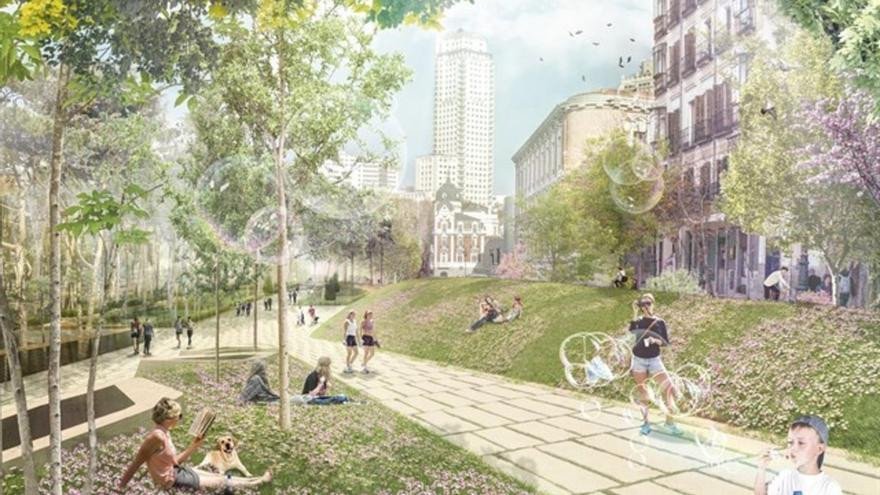
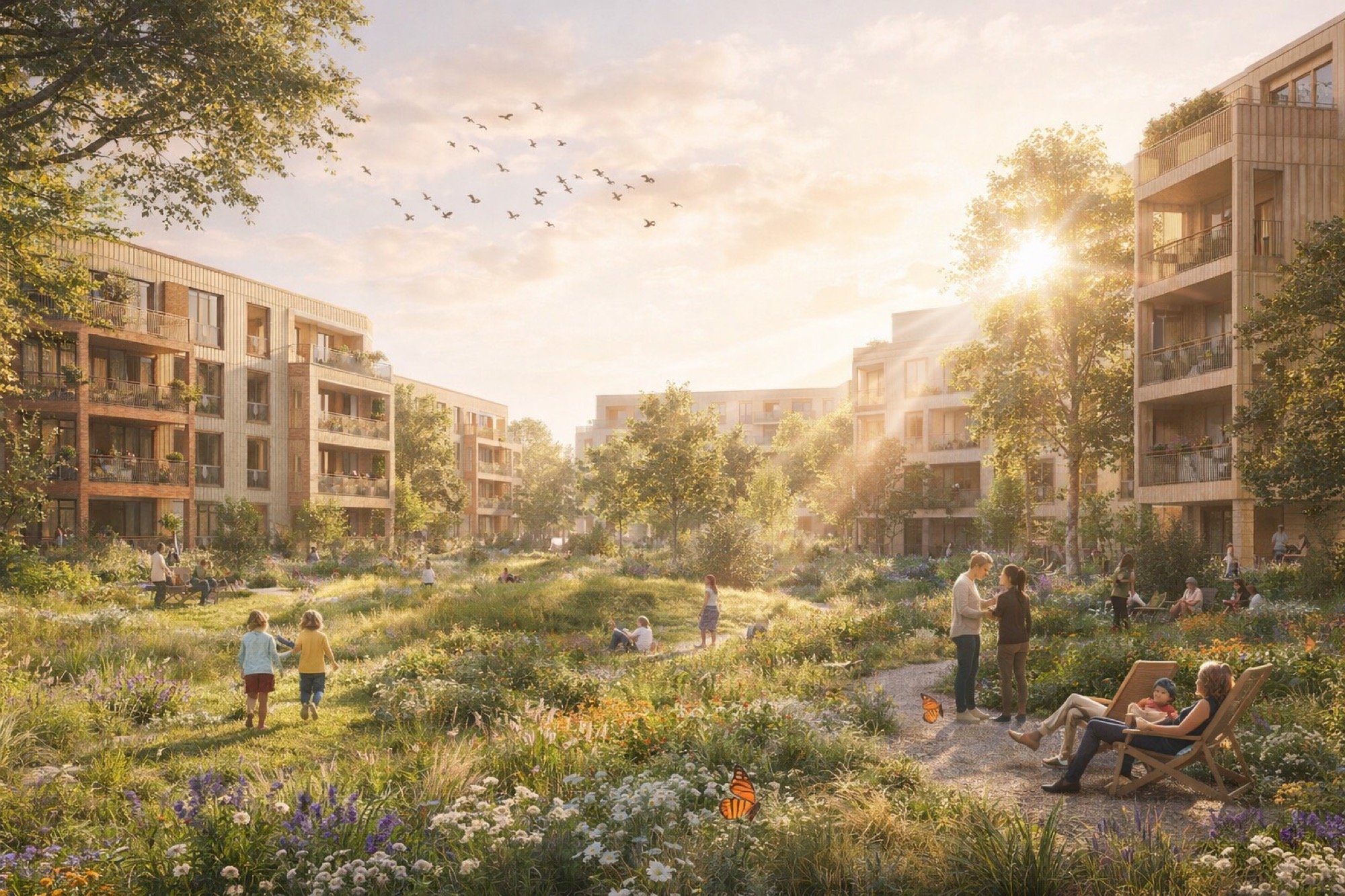
Park before anti-render. Source: AntiRender.
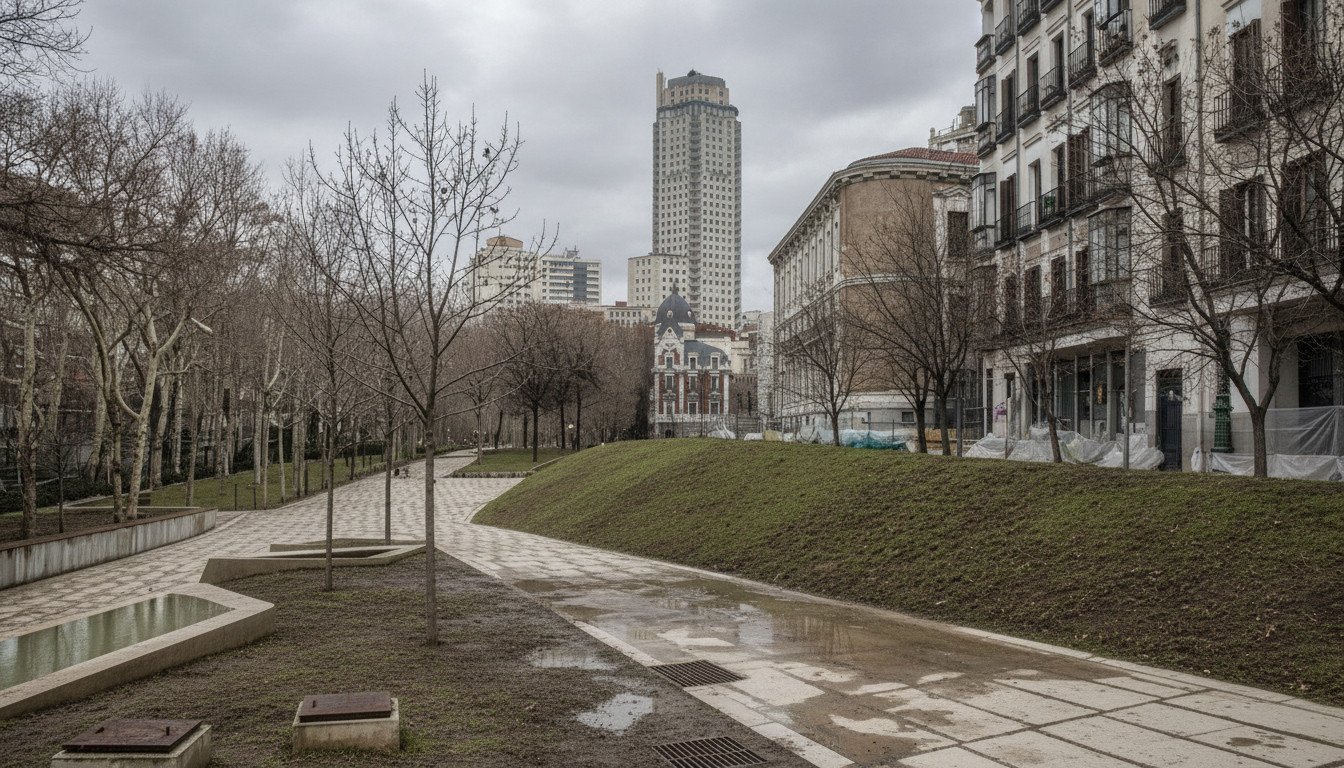
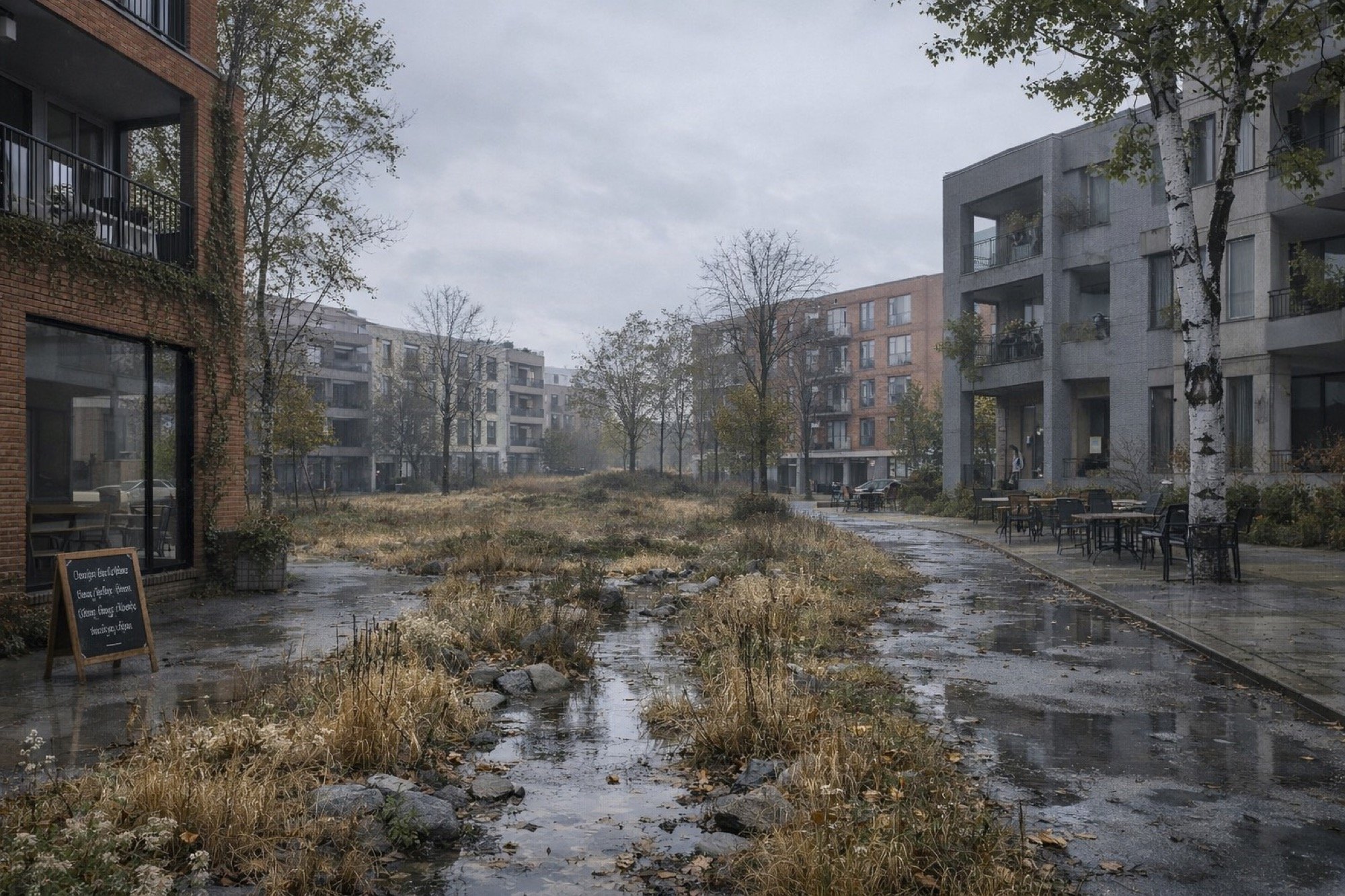
Park after anti-render. Source: AntiRender.
Perhaps this also reframes what we call a “realistic render”. If realism means resemblance to reality, then a damp November Tuesday is no less real than a golden May afternoon. Anti-render simply widens the spectrum of what counts as plausible, returning realism from seasonal marketing to the full calendar of use, weather and time.
As a fun check on how our designs might actually appear, the following prompt, pasted into Gemini, produces the anti-render images shown above:
Transform this idealized architectural rendering into the most brutally realistic, depressing photograph possible. This is the WORST CASE scenario – what the building will actually look like in reality:
– Set on a dreary, grey, overcast late November day with flat, lifeless lighting – The sky is a uniform dirty grey, threatening rain – All trees are completely bare – just skeletal branches against the grey sky – The landscaping is dead, muddy, or non-existent. No lush gardens, just patchy brown grass and bare dirt – Remove ALL people, the scene should feel empty and abandoned – Any water features should look stagnant and grey – Add realistic weathering, dirt streaks, and construction residue on the building – The building materials should look how they actually appear, not the idealized clean version – Include visible utility boxes, drainage grates, and other
The problems of photorealistic rendering from a single vantage point are well addressed. Yet anti-render does not only invert the image; the tool strips away that atmospheric bullshit. It targets the cheerful sentiment, the birds and bees, cyclists gliding through golden light, children flying kites, the calibrated golden hour and season. In response, it offers an equally stylised opposite: a perpetually ruinous landscape, tuned to worst-case conditions. The oscillation between the two exposes a useful discomfort: how much do we believe in what we are drawing, and how much must be dressed up?
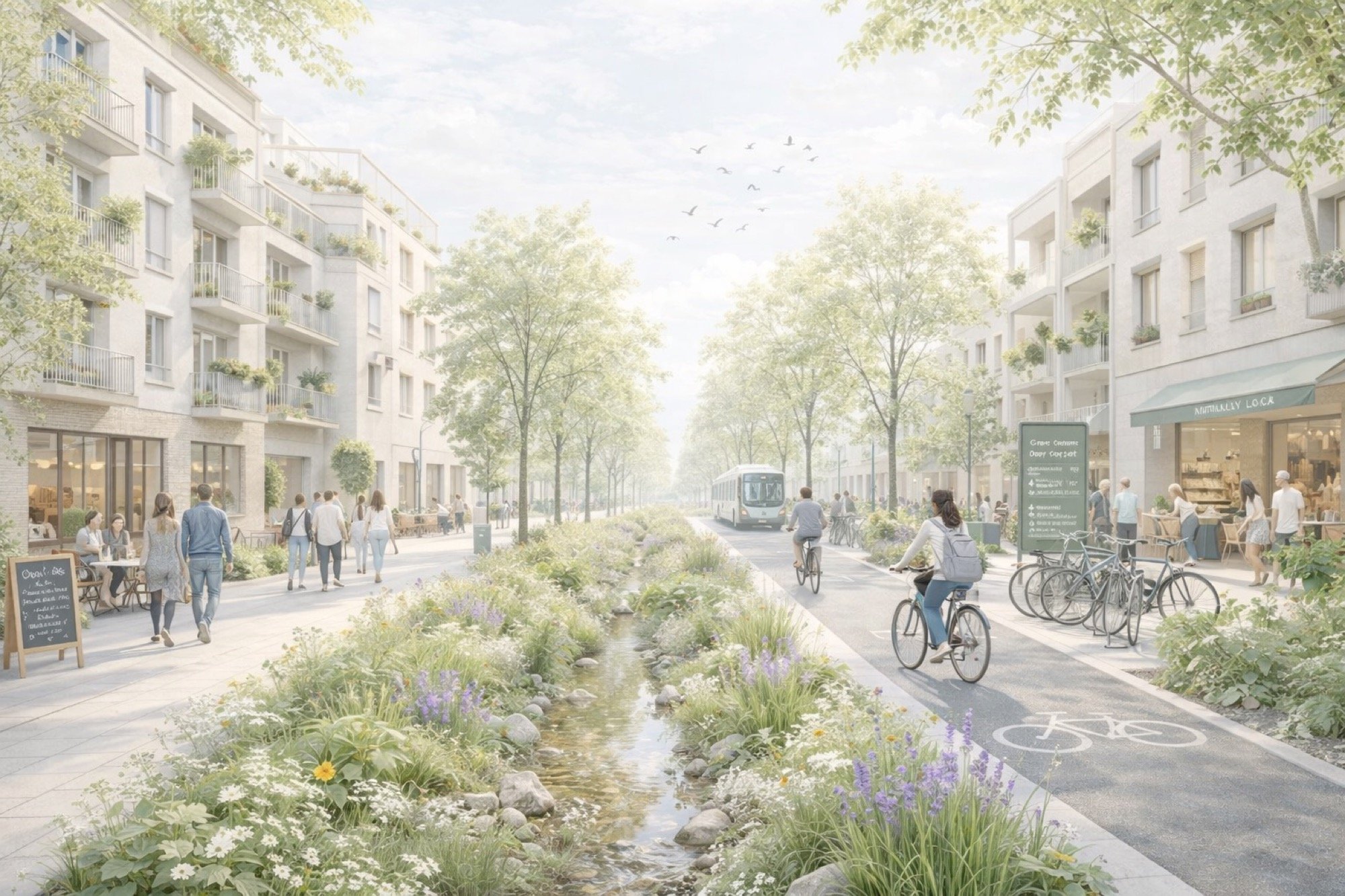
AI-created “happy” render.
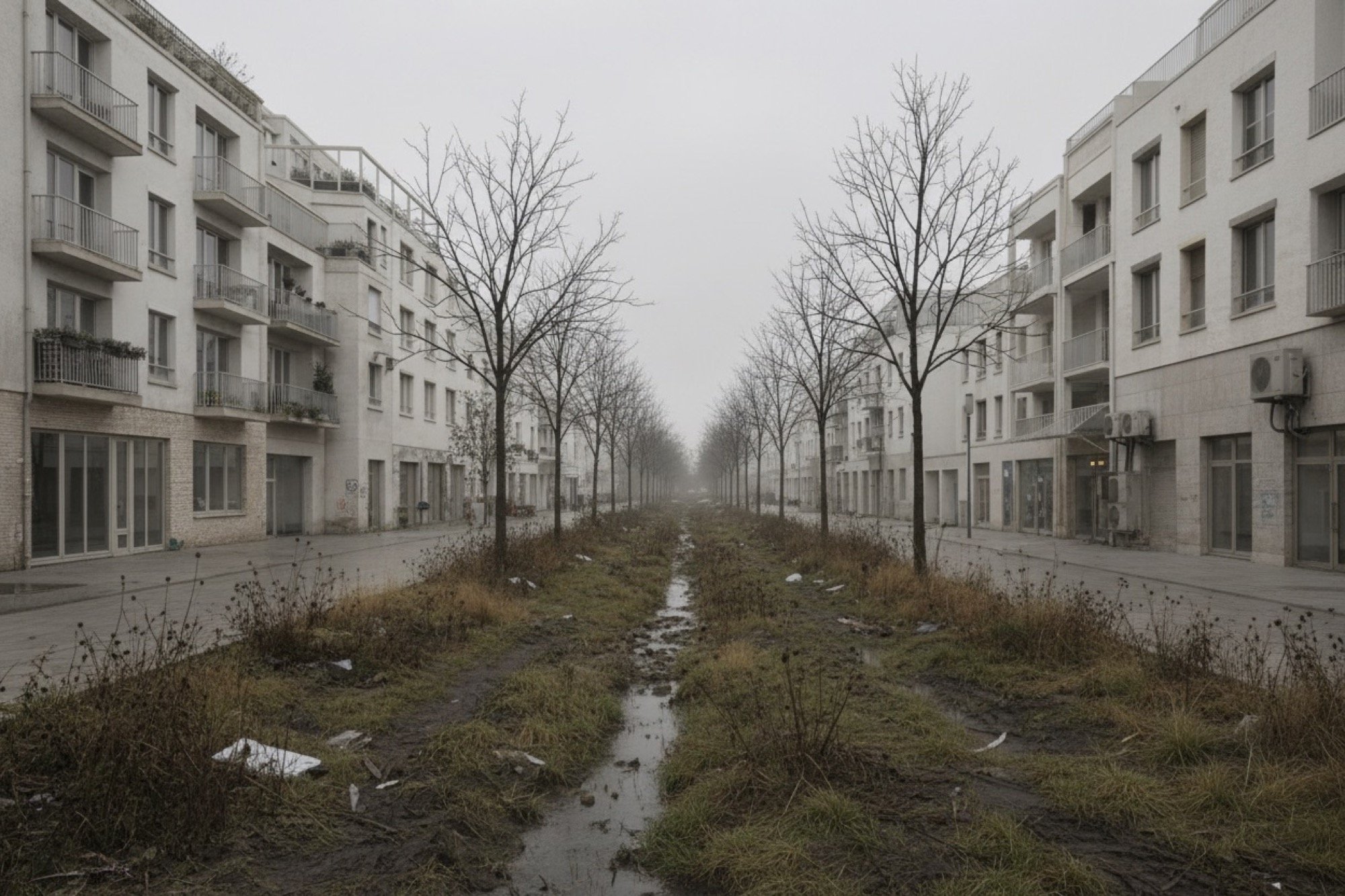
AI-created render without happy, healthy people, on a bleak rainy day.
In a moment in time, when trees are bare, what remains are the structural elements of the design and a question: have we got those right beyond “just another generic greenspace”? If we erase ourselves from the picture as designers, and thus the perception of users, we may remove ourselves from society.
AI-created render with sun rays, birds, butterflies, kids playing, flowers blooming.
AI-created, de-rendered render. If the design parts of the project work, the project should uphold the derendering process.
While AI often pushes towards extremes, plunging into deepfakes, by guessing and learning our expectations, it can also produce a humorous effect of the “radical” reality-check, where ugly, bad and dirty become a relief from the pressure to sustain the dream. However, when a project already works with the ugly, bad and dirty, there is not much for an AI anti-render to do. Accepting the uncertainty of the new climate conditions, where messiness becomes welcome, as long as it grows and sustains life, is a paradoxical condition between design and no design. Holding the door open for the designed and ugly at the same time could help de-harmonise rainbows farts with graffiti, beer cans and people smoking cigarettes against a backdrop of shabby bushes.
2 thoughts on “Deepfakes of Blue Skies: A November Reality Check”
I visited the anti-render website and discovered that it is essentially an advertising strategy for a self-described classical architect. The website then invites users to consider how the project might have appeared if it had been designed to look appealing in November. To support this idea, it introduces the “anti-antirender,” an AI tool specifically developed for this purpose. Following this suggestion, I tested the tool by submitting an image of the Berlin National Gallery sourced directly from Wikipedia. I did a screenshot and send it: in a few seconds I obtained a dull 19th century post office in return! maybe we don’t need all the so called “generative” tools.
To provide the best experiences, we use technologies like cookies to store and/or access device information. Consenting to these technologies will allow us to process data such as browsing behavior or unique IDs on this site. Not consenting or withdrawing consent, may adversely affect certain features and functions.
Functional
Always active
The technical storage or access is strictly necessary for the legitimate purpose of enabling the use of a specific service explicitly requested by the subscriber or user, or for the sole purpose of carrying out the transmission of a communication over an electronic communications network.
Preferences
The technical storage or access is necessary for the legitimate purpose of storing preferences that are not requested by the subscriber or user.
Statistics
The technical storage or access that is used exclusively for statistical purposes.The technical storage or access that is used exclusively for anonymous statistical purposes. Without a subpoena, voluntary compliance on the part of your Internet Service Provider, or additional records from a third party, information stored or retrieved for this purpose alone cannot usually be used to identify you.
Marketing
The technical storage or access is required to create user profiles to send advertising, or to track the user on a website or across several websites for similar marketing purposes.
To provide the best experiences, we use technologies like cookies to store and/or access device information. Consenting to these technologies will allow us to process data such as browsing behavior or unique IDs on this site. Not consenting or withdrawing consent, may adversely affect certain features and functions.
Functional
Always active
The technical storage or access is strictly necessary for the legitimate purpose of enabling the use of a specific service explicitly requested by the subscriber or user, or for the sole purpose of carrying out the transmission of a communication over an electronic communications network.
Preferences
The technical storage or access is necessary for the legitimate purpose of storing preferences that are not requested by the subscriber or user.
Statistics
The technical storage or access that is used exclusively for statistical purposes.The technical storage or access that is used exclusively for anonymous statistical purposes. Without a subpoena, voluntary compliance on the part of your Internet Service Provider, or additional records from a third party, information stored or retrieved for this purpose alone cannot usually be used to identify you.
Marketing
The technical storage or access is required to create user profiles to send advertising, or to track the user on a website or across several websites for similar marketing purposes.






I visited the anti-render website and discovered that it is essentially an advertising strategy for a self-described classical architect. The website then invites users to consider how the project might have appeared if it had been designed to look appealing in November. To support this idea, it introduces the “anti-antirender,” an AI tool specifically developed for this purpose. Following this suggestion, I tested the tool by submitting an image of the Berlin National Gallery sourced directly from Wikipedia. I did a screenshot and send it: in a few seconds I obtained a dull 19th century post office in return! maybe we don’t need all the so called “generative” tools.
🙂