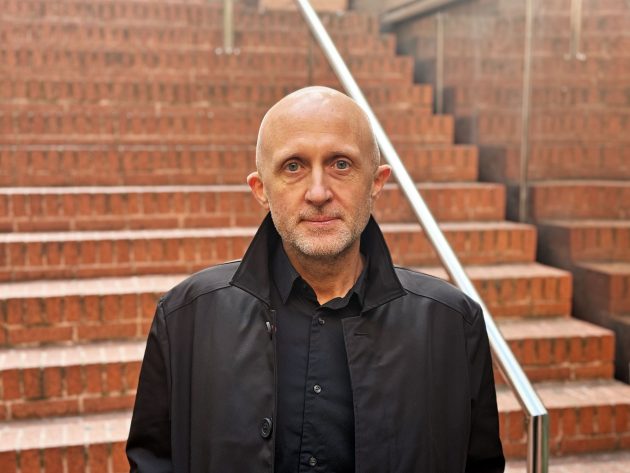
Ed Wall is Professor of Cities and Landscapes at the University of Greenwich, where he leads the Spatial and Digital Ecologies research centre. He is a Visiting Professor at the Politecnico di Milano and has previously served as Visiting Professor at Harvard University Graduate School of Design and also as City of Vienna Visiting Professor for Urban Culture, Public Space and the Future at TU Vienna. Wall founded Project Studio as a platform for design and research collaborations, with work exhibited internationally at institutions including the Van Alen Institute, the Royal Academy, and the Garden Museum. His research explores architectural practices and landscape processes through concerns for spatial justice. He has lectured widely, including at Harvard University, Columbia University, and the Architectural Association.
Ed Wall: There’s a curiosity that’s been driving me for a while: I am interested in the important emerging practices we need to think through, invent, and form. Most of my work is with students, supporting them in their learning so they can develop or imagine new forms of practice—practices that address contemporary challenges like the climate crisis, global conflicts, or urban injustice. The range of challenges drives this work, but also a responsibility to support younger practitioners. Those of us who have been in the field longer need to make space for younger designers, practitioners experimenting in ways that haven’t been tried before. I think that’s extremely important.
But curiosity suggests that you are also a bit restless in mainstream education and knowledge production. So toward which directions or which notions in how landscape architecture is taught today would you oppose?
Certainly there’s a restlessness. Many of us come into academic teaching with a critique of how our own education unfolded, and that’s true for me, particularly regarding my landscape architecture education. But I also critique some prevailing professional approaches. I worked in practice for a number of years before returning to the academy, and I recognise that we need new practices if we are to address the challenges we now face.
We do see practitioners engaging with environmental, climate, social, and even economic challenges in their projects, but we still see a mainstream of commercial practices that continue with business as usual, much like I was trained, and as many were trained decades earlier. If we truly recognise that we face different crises now than even a decade ago, then new practices are urgent.
How I do that in the university is partly through my teaching and partly through my research. Much of my writing critiques the worlds of which we are a part: not just design practitioners or landscape architects, but the very ways in which we engage with “landscape,” how we might see it differently and form it in positive ways. Examples of this are Collective Landscape Futures, which explores the collective nature of landscape practices, as well as the Field Office Workshops that we set up to explore new practices grounded in their relationship to fieldwork.
The other part of the work is teaching. We teach differently. At Greenwich, we’ve developed approaches aimed at working with the complexity of landscapes—whether multi-scalar complexities, conditions like pollution, or ethical realities. We work hard to craft our curriculum: sometimes making significant changes to programmes, sometimes refining single seminars, always trying to support students in that work.
An example: coming out of the COVID pandemic, many of us recognised we had been working in isolation for too long, working too much on screens. Developing more materially grounded studio teaching, requiring in-person time in workshops and studios, was an important step in addressing shared concerns of students and educators. Similarly, we recognised the need to return to fieldwork and community engagement. It has taken time to regain trust with communities and stakeholders, because the pandemic largely distanced us from each other and from the people who should be informing the design process.
When you say complexity, with evolving technologies, we get more data about the landscape now than ever before. Landscape becomes excessive, a hypertopia. How do you prepare students to confront this complexity?
I think we often overuse the word complexity—I overuse it. In landscape architecture, where we now have increasing amounts of quantitative data through platforms like GIS, and a greater awareness of the importance of fieldwork, community engagement, and more-than-human systems, there is simply an excess of data. Maybe we should replace “complexity” with “noise.” There’s a deafening nature to landscapes and to practice, especially with the intensity of digital data and the rapid speed of change. Finding a way to filter that noise is extremely important.
The techniques we use at the university are designed to give clear direction in the earlier years: we ask for fewer pieces of work, produced at a slower pace. We sometimes ask students to develop one drawing a week, encouraging slower milestones, so that students can take more care in individual explorations. Landscape architects cannot do everything in a single project, but they can be rigorous in their selection of data, and this can make the work more precise.
Image by Rachel Clements (MLA Landscape Architecture, 2024, University of Greenwich)
How do you encourage them to develop their own noise filters?
As students move from semester to semester and year to year, they are afforded more freedom—and with that comes the expectation that they will filter out less useful information for themselves. They need to be able to work within the noise yet recognise, partly through intelligence, partly through intuition, partly through experience and careful study, which data is useful for addressing the challenges of particular projects. It is one of the greatest challenges we face today, even before we add the chaotic noise that comes with AI.
Speaking of things to learn—what should landscape architects unlearn?
Unlearning is important for all of us. We come into landscape architecture with expectations of what it is, but we need to bring a freshness to every project, to be excited by every landscape. There are many things we need to unlearn, individually and as a profession, but one important thing is the fixity of the traditional stages of design and construction. We need to see landscapes as more open-ended entities that require maintenance, management, stewardship—creative processes in themselves, not isolated from traditional design practice.
And when you say open-ended, is it also about letting go of control as a designer?
Certainly, and this relates both to the problems of noise and to the traditions we’ve inherited from architecture and engineering, with their ambitions of control. We need to recognise how to cede control—to communities, to more-than-human entities—in careful and responsible ways. But we also have a responsibility to keep space open, to keep opportunities open for others to engage. We don’t let go of control so that powerful organisations or landowners can simply fill the space; we do it to make space and time for people and entities less visible and less heard.
I believe we should strategically give space to others. It takes enormous energy and creativity to hold that space open. For me, much of that energy goes into holding space for students and for the voices young people should have in the profession. In large landscape and architectural projects, I think we need more open-ended inquiry into what an unfinished landscape might be. When we put pen to paper—whether design proposals, management documents, maintenance schedules—we are still only shaping an unfinished landscape.
We see this in some recent projects; Martí Franch from EMF talks about the unfinished nature of the Parco della pace they designed together with PAN Associati. We have also been exploring it in Greenwich for over 10 years, through techniques such as Incomplete Cartographies. It’s in the discourse, but it takes additional effort to translate those priorities into reality. It is, in a way, reinventing the design process.
How would you define what landscape is doing today—or what it should be doing?
I think the role of the landscape architect has enormous potential. It is increasingly urgent as an environmental, ecological, social practice. Here at the Biennial in Barcelona, we are surrounded by exceptional designers innovating at the forefront of the field, and I feel extremely optimistic. There are projects that are inventive and leading practice in new directions.
Image by Flynn Morton (MLA Landscape Architecture, 2024, University of Greenwich)
But beyond project work, I believe we need space for new kinds of organisations and firms—greater diversity in practice models. Not just traditional commercial studios, but charities, non-profits, NGOs, third-sector landscape practices. We see this in organisations like MASS Design, but there needs to be more space for it.
We also need more support for young people leaving university to establish their own studios. Financial pressures, cost of living, housing, and student debt—all make it difficult. The profession, like architecture, has seen consolidation into larger firms, with fewer new emerging studios. I believe the profession has a responsibility to ensure that stimulating practices can exist at smaller scales, able to coexist with the larger international firms that have grown so dominant in the last two or three decades.
What would be your advice to students or young professionals?
There is so much potential in the field. It’s important for young professionals to reflect on their own practices as they move through university and into professional life. Whether they become employed or set up their own studios, they need to be able to express and exert themselves strongly. They need to recognise what their particular practice is—carrying with them an ethos, techniques, methods, and skills particular to their own ambitions, circumstances, and responsibilities.
Zaš Brezar (b. 1984, Socialist Federal Republic of Yugoslavia/Slovenia) is founder and editor-in-chief of Landezine. Educated as a landscape architect (University of Ljubljana), he spent several years in practice, later establishing Landezine in 2009. He is focused on the production of space, specifically mapping, tracing and interpreting the course of landscape architecture and questioning its role in society and politics of public space. For his work with Landezine, he received Plečnik Medal in Slovenia in 2025.
Ed Wall is Professor of Cities and Landscapes at the University of Greenwich, where he leads the Spatial and Digital Ecologies research centre. He is a Visiting Professor at the Politecnico di Milano and has previously served as Visiting Professor at Harvard University Graduate School of Design and also as City of Vienna Visiting Professor for Urban Culture, Public Space and the Future at TU Vienna. Wall founded Project Studio as a platform for design and research collaborations, with work exhibited internationally at institutions including the Van Alen Institute, the Royal Academy, and the Garden Museum. His research explores architectural practices and landscape processes through concerns for spatial justice. He has lectured widely, including at Harvard University, Columbia University, and the Architectural Association.
To provide the best experiences, we use technologies like cookies to store and/or access device information. Consenting to these technologies will allow us to process data such as browsing behavior or unique IDs on this site. Not consenting or withdrawing consent, may adversely affect certain features and functions.
Functional
Always active
The technical storage or access is strictly necessary for the legitimate purpose of enabling the use of a specific service explicitly requested by the subscriber or user, or for the sole purpose of carrying out the transmission of a communication over an electronic communications network.
Preferences
The technical storage or access is necessary for the legitimate purpose of storing preferences that are not requested by the subscriber or user.
Statistics
The technical storage or access that is used exclusively for statistical purposes.The technical storage or access that is used exclusively for anonymous statistical purposes. Without a subpoena, voluntary compliance on the part of your Internet Service Provider, or additional records from a third party, information stored or retrieved for this purpose alone cannot usually be used to identify you.
Marketing
The technical storage or access is required to create user profiles to send advertising, or to track the user on a website or across several websites for similar marketing purposes.
To provide the best experiences, we use technologies like cookies to store and/or access device information. Consenting to these technologies will allow us to process data such as browsing behavior or unique IDs on this site. Not consenting or withdrawing consent, may adversely affect certain features and functions.
Functional
Always active
The technical storage or access is strictly necessary for the legitimate purpose of enabling the use of a specific service explicitly requested by the subscriber or user, or for the sole purpose of carrying out the transmission of a communication over an electronic communications network.
Preferences
The technical storage or access is necessary for the legitimate purpose of storing preferences that are not requested by the subscriber or user.
Statistics
The technical storage or access that is used exclusively for statistical purposes.The technical storage or access that is used exclusively for anonymous statistical purposes. Without a subpoena, voluntary compliance on the part of your Internet Service Provider, or additional records from a third party, information stored or retrieved for this purpose alone cannot usually be used to identify you.
Marketing
The technical storage or access is required to create user profiles to send advertising, or to track the user on a website or across several websites for similar marketing purposes.