The 140 m long "Golden Bridge" arrives to Stockholm from China where it was produced. photo by Joakim Jardenberg
Landscape architecture documents the landscapes it produces. It rarely documents the landscapes it consumes.
The professional culture of the discipline is predominantly built around showing finished work. Publications and platforms, such as Landezine, show plans, sections, photographs, and texts that describe what has been built and how it performs. What remains largely invisible are the ‘awayscapes’ that supplied the materials that made these projects possible. Landscape architecture analyses sites with increasing precision. The territories embedded within them through material displacement seldom enter project knowledge or the experience of a designed landscape.
This is because the structure of project delivery in most cases separates design from sourcing. Landscape architects define spatial intent, and then the procurement processes determine what is actually bought, often based on price, availability and delivery schedules. This varies from country to country, but contractors frequently substitute materials, and final sourcing decisions often differ from what designers originally imagined. This is where a gap emerges.
Golden Bridge in Slussen, Stockholm, Sweden, designed by Foster + Partners
Public projects already require public presentations of design proposals before construction. An equivalent public moment could follow completion, where the material reality of the project is represented. As a short publication, an exhibition, an event, a website appendix, or even a single diagram could show which other landscapes produced materials or elements that are being displaced.
Landscape architecture depends on territorial displacement it does not narrate.
Such documentation would not only inform professional reflection. It would also make visible to users that a local landscape is composed of fragments of many others. Furthermore, the displaced materials temporarily became part of other landscapes they passed through: ports, shipping routes, storage yards and transport corridors.
Liam Young traces these extraction sites and transition corridors, chasing the reality behind the products and architecture we use on a daily basis. See this interview we made with Young a few years back.
The profession increasingly defines itself through ecological responsibility; biodiversity, water systems, soil processes and climate adaptation are by now well-embedded concerns. If ecological responsibility is taken seriously, it cannot logically stop at the project boundary, nor at symbolic ecological gestures and “ecological aesthetics”. Materials with their respective extraction sites also belong to ecological systems, as they also produce landscape and climate change. If the discipline claims responsibility for improving landscapes where it intervenes, it is reasonable to also understand the landscapes that were altered to make those interventions possible. Landscape architects already possess the methods to read landscapes as consequences of material transformation.
This is where the discipline needs to act and open up a new space of inquiry. Landscape architecture has repeatedly and successfully expanded what counts as relevant project knowledge. Material sourcing represents another such expansion. A simple question needs to become a normal practice: What landscapes were transformed to make this project possible?
One practical way to address this would be to introduce an additional analysis step after construction: a sourcing review documenting where major materials came from, what substitutions occurred, what landscapes and what territorial flows made the project possible. Such a step would not expand regulation but would expand project knowledge to represent the web of supply chains.
A stone from Norway was transported to Germany to form a part of the architecture of the Norwegian Embassy in Berlin, designed by Snøhetta. In this case, the displacement becomes a part of the meaning of the site.
This way of understanding projects as reorganisations of displaced matter is not new. Robert Smithson already described cultural production as a process of material relocation linking quarries, construction sites and monuments into a single territorial system. In Extrastatecraft (2014), Keller Easterling argues that contemporary spatial production is shaped less by visible form and more by hidden infrastructures such as supply chains, standards, logistics and procurement systems: “Design traditionally focuses on objects, while real spatial power sits in the background systems that organise them.”
What remains missing, at least for landscape architects, is a translation of this thinking into everyday office procedures.
Jane Hutton argues that every project is composed of landscapes transformed elsewhere through extraction. Her book, Reciprocal Landscapes is a deep dive into the subject and offers invaluable insights into case studies and the ethics of material displacement.
Reciprocal Landscapes: Stories of Material Movements – Jane Hutton for AA School of Architecture
Full traceability is difficult to achieve but major material categories such as stone, timber, steel and plants are already traceable through existing supply documentation. Material passports, certificates such as FSC, PEFC, EPDs, and plant passports already track origin. These systems, along with those in food production, demonstrate that tracing material origin is technically possible. What remains largely absent is their spatial interpretation: translating this information into a landscape reading of the territories transformed through extraction, processing and transport.
So the task at hand is therefore not technical invention but selective documentation and then representation. If the aesthetic experience of such accounts produces a sense of alienation, a sense of matter being out of place, we need to confront it as those ‘foreign’ substances already form the familiar image. We are simply not sufficiently aware of them.
Since landscape architects, in most cases, do not control final sourcing decisions, they can claim an overview: documenting what, and where from, was actually delivered rather than what was originally specified. This does not imply field research into distant sites, with boots on the ground, but rather an inquiry into available spatial evidence: satellite imagery, photographs, supplier documentation, transport routes and publicly available information on extraction and processing. The task is not to investigate these landscapes directly, but to construct a spatial account of the territorial transformations that made the project possible. Through mapping, diagrams or simple visual narratives that landscape architecture knows very well, these distant landscapes could become perceptible as part of the project itself. So in that sense, landscape architecture could make supply chains visible not as data, but as landscapes.
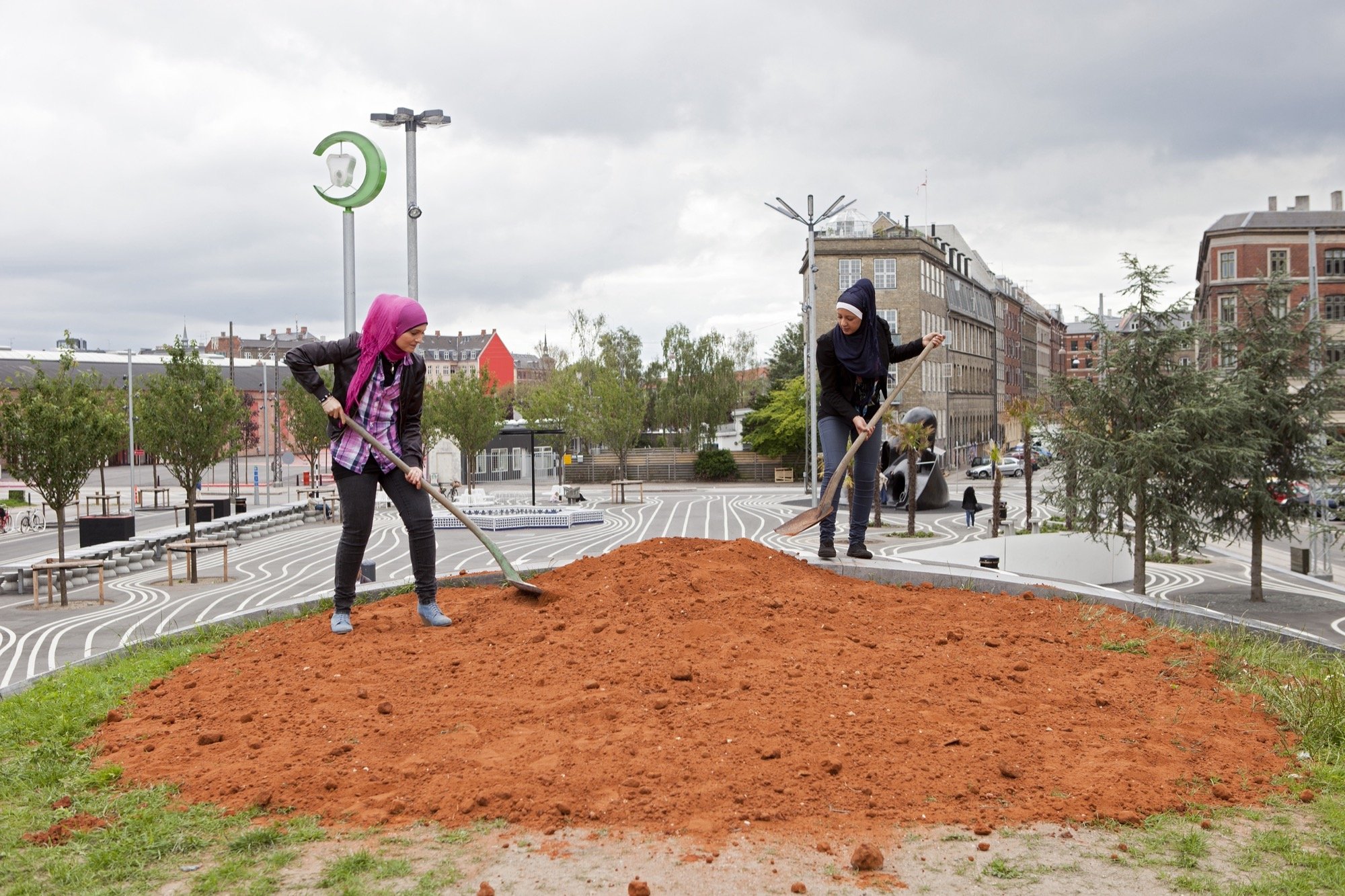
Palestinian Soil in Superkilen, Copenhagen, Denmark, designed by Topotek 1, BIG, Superflex, photo by Torben Eskerod
Few elements in Superkilen park are Danish. Many were produced elsewhere and transported to the site, to emphasise the neighbourhood’s multi-cultural character. In this project, supply chains act as an intentional design narrative rather than hidden logistics.
Projects could include an additional professional step: a sourcing review documenting where the main materials came from, what substitutions occurred, how far they travelled, and which territorial flows made the project possible. A project would then not only evaluate how a landscape performs, but also what other landscapes it engaged to exist. This step combines documentation (Material Provenance Report, already known) and interpretation (Landscape Consequence Analysis).
A Material Provenance Report can establish where materials came from and represent them spatially. But landscape architecture can go further. It can interpret the landscape consequences of the processes that sustain those materials. This means treating awayscapes as landscapes in their own right, as territories shaped by extraction, cultivation, processing, logistics and labour.
Its value would be cumulative, and over time, practitioners would begin to see patterns across projects. Certain materials will consistently come from distant sources, while others will prove locally available. Some will do less harm than others. Some substitutions will reveal hidden dependencies within the construction economy.
The ‘sense of place’ needs to be acknowledged through the geographies embedded in supply chains. Otherwise, it turns into an aesthetic surface traditionalism, hiding its material contradictions of displacement, as the ecological crisis continues.
This does not require new regulations but insists on professional attention, of what the discipline chooses to observe, record and make visible. Landscape architecture already shapes how landscapes are understood, and it could also begin to shape how their hidden geographies are presented.
Documenting the landscapes a project consumes would not change construction overnight. But it would change what the profession sees as part of its responsibility. Projects would appear as what they are; embedded in territorial negotiations. That awareness expands disciplinary knowledge and can reform perception by making hidden processes a part of the experience.
Every built landscape would then carry two documents: one describing what it became, and another describing where it came from and what footprint was left there. Only when both are visible can a project be sufficiently understood.
Every landscape is made of other landscapes, and every landscape project transforms landscapes beyond its site.
Zaš Brezar (b. 1984, Socialist Federal Republic of Yugoslavia/Slovenia) is founder and editor-in-chief of Landezine. Educated as a landscape architect (University of Ljubljana), he spent several years in practice, later establishing Landezine in 2009. He is focused on the production of space, specifically mapping, tracing and interpreting the course of landscape architecture and questioning its role in society and politics of public space. For his work with Landezine, he received Plečnik Medal in Slovenia in 2025.
To provide the best experiences, we use technologies like cookies to store and/or access device information. Consenting to these technologies will allow us to process data such as browsing behavior or unique IDs on this site. Not consenting or withdrawing consent, may adversely affect certain features and functions.
Functional
Always active
The technical storage or access is strictly necessary for the legitimate purpose of enabling the use of a specific service explicitly requested by the subscriber or user, or for the sole purpose of carrying out the transmission of a communication over an electronic communications network.
Preferences
The technical storage or access is necessary for the legitimate purpose of storing preferences that are not requested by the subscriber or user.
Statistics
The technical storage or access that is used exclusively for statistical purposes.The technical storage or access that is used exclusively for anonymous statistical purposes. Without a subpoena, voluntary compliance on the part of your Internet Service Provider, or additional records from a third party, information stored or retrieved for this purpose alone cannot usually be used to identify you.
Marketing
The technical storage or access is required to create user profiles to send advertising, or to track the user on a website or across several websites for similar marketing purposes.
To provide the best experiences, we use technologies like cookies to store and/or access device information. Consenting to these technologies will allow us to process data such as browsing behavior or unique IDs on this site. Not consenting or withdrawing consent, may adversely affect certain features and functions.
Functional
Always active
The technical storage or access is strictly necessary for the legitimate purpose of enabling the use of a specific service explicitly requested by the subscriber or user, or for the sole purpose of carrying out the transmission of a communication over an electronic communications network.
Preferences
The technical storage or access is necessary for the legitimate purpose of storing preferences that are not requested by the subscriber or user.
Statistics
The technical storage or access that is used exclusively for statistical purposes.The technical storage or access that is used exclusively for anonymous statistical purposes. Without a subpoena, voluntary compliance on the part of your Internet Service Provider, or additional records from a third party, information stored or retrieved for this purpose alone cannot usually be used to identify you.
Marketing
The technical storage or access is required to create user profiles to send advertising, or to track the user on a website or across several websites for similar marketing purposes.